Real-world taxonomy use cases
Every use case in this section comes from a real conversation with a CX, quality, or insights leader over the past year, describing what they want to do, or are already doing, with their conversation data. Quotes are verbatim (lightly cleaned for filler words), verified against the source transcripts, and anonymized by role and industry.
Contact drivers you can actually drill into
Helpdesk categories tell you that volume went up, not why.
I can recall all the tickets that were related to that new product, and then I can sort them by the contact reason. But from there, that's where it ebbs. You can't get to the granular.
director of customer care, consumer pet-tech COmpany
If the intent was to schedule an appointment and you could not, then why not? … These four reasons make up the 100 percent of why not. So we don't have that today.
patient-access leader, academic health system (about 300 people handling well over 100,000 calls a month)
Churn-reason classification by product line
We’re building reporting on what are the specific churn reasons for customers that are specifically using [one product], and are they product limitation or service based.
CX quality lead, HR software company
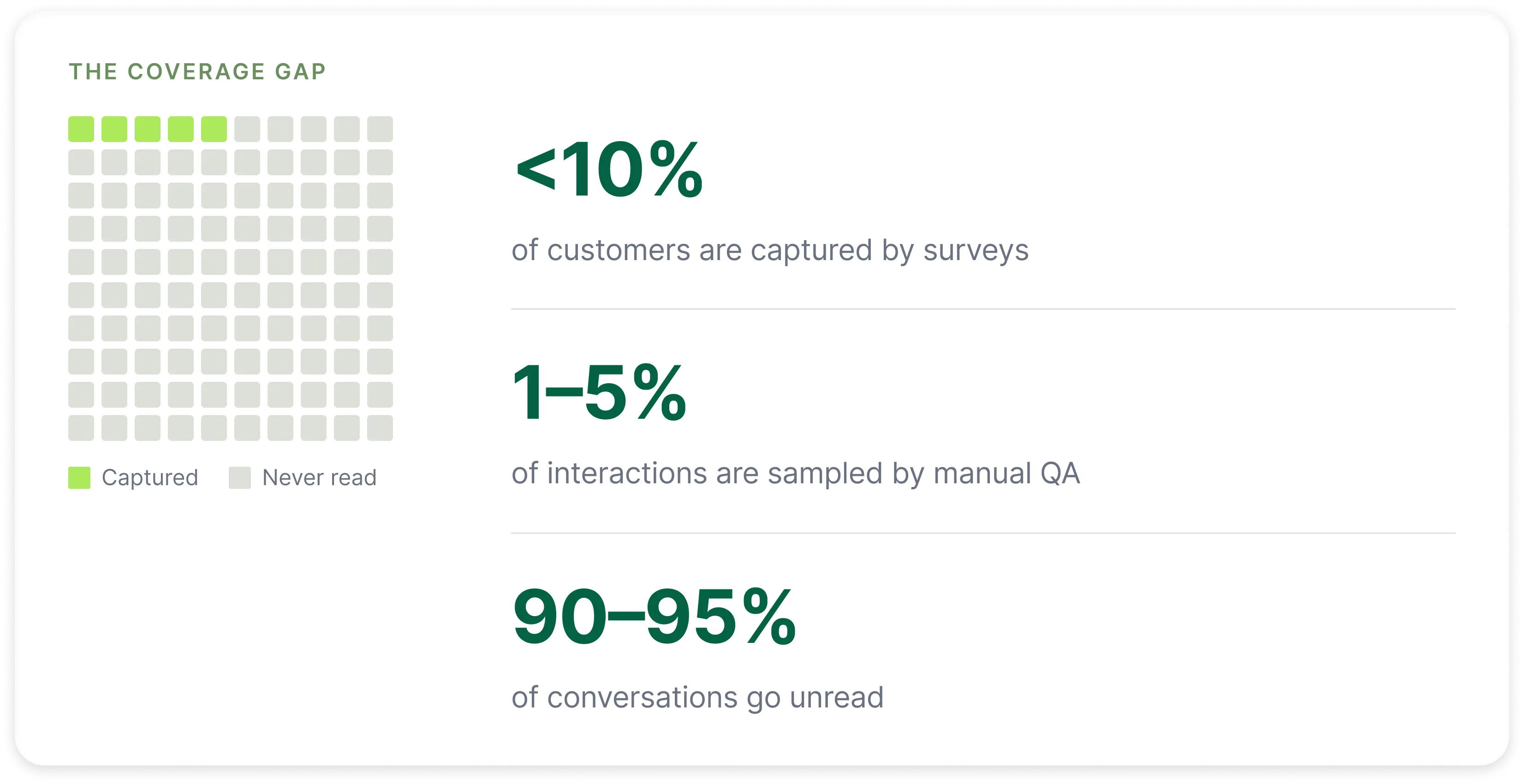
There's 80 percent of tickets on average that do not receive a survey, either because we may not have one attached to that particular issue type, or players decide not to give us a survey, or it times out. We're finding that there could be value in those 80 percent.
Quality manager, mobile gaming
Predicting churn better than your agents can
A buy-now-pay-later fintech turned conversations into a churn model, and benchmarked it against humans:
We have a model that predicts 80 percent whether they're going to churn or not based on the conversation. We also did a contest with our agents (hey, predict whether they're going to churn based on your conversation) and they had like a 30 percent success rate.
buy-now-pay-later fintech
A retention leader at a fiber ISP uses classification to level-set the save opportunity:
Out of this pool (cancellation request) we saved four. And of that pool we attempted to save 104… as just a level set of what we're looking at.
retention leader, fiber ISP
A CX quality manager at a robo-advisor used classification to answer a board-level question, typing this request into their workspace:
I need insights into why customers chose to defund and/or close their accounts… and what percentage of that churn can be reasonably attributed to the [recent] security incident.
CX quality manager, robo-advisor
Indirect churn signals and save plays
I want to pull the tickets that maybe had two dings for a direct churn risk or even indirect churn risk, build a report off of that, have our support team follow up, and then three months down the road show the executives that these members are still enrolled because we followed up.
voice-of-customer analyst, virtual healthcare provider
Root causes ranked by cost to serve
I would love to better split our data by root causes… to find the exact customer problems that take us the longest to solve, and then see if we can make a business case to build better solutions into the product.
service quality lead, HR software company
A CX leader at a sports-betting operator did exactly that for promotions:
[One promo type] is growing as a share of volume and customers are getting more pissed off about it… so we pulled in 10,000… it broke down exactly what about every promo went wrong.
CX leader,sports-betting operator
Failure-mode triage: people, process, or product
We want to understand the whole customer experience and all of the points where we're failing, and then break them down into which areas we need to fix: is it the training gaps, is it the knowledge base, is it just our process in general?
CX lead, online gaming company
Product feedback with revenue attached, and decisions gated on counts
A CS operations lead at a talent-acquisition SaaS company classified a year of cases against a single product gap:
I was basically able to extract that we had 288 cases… and turn this into a $65 million ARR impact point for 138 customers: find the top five themes, provide that back to the product manager directly.
CS operations lead, talent-acquisition SaaS company
The same logic runs in reverse, using counts to unblock decisions.
We just want to implement a change, but without knowing how many calls are coming in for this certain call type, we cannot make a decision.
collections QA lead, BNPL company
An edtech team even stood up a classifier before the event it measures:
We are actually removing [a] feature tomorrow from our website and we want to know how many customers reach out to us about this feature removal.
Edtech Team
Emerging-issue detection before agents flag it
We're thinking about better incident detection, ways that we can notice trends as they're happening. Here's all the ones we've tagged as known incidents. Can you find ones that don't match this criteria?
support operations admin, fintech banking platform
A CX operations analyst at a healthcare platform explained why speed matters:
By the time it's flagged by an agent, five, six, seven days have passed already, and we knew that we could find these earlier based off the new tickets coming in.
CX operations analyst, healthcare platform
Her team now runs classifiers on open tickets to:
Identify emerging trends prior to a human agent intervention… to try and jump ahead of the dissatisfaction.
CX operations analyst, healthcare platform
Sometimes the outside world moves first. A ticket-resale marketplace discovered a resale-policy change only when customers wrote in:
We're not finding out about it until fans are contacting our support team.
ticket-resale marketplace
They then used classification over tens of thousands of tickets to size the impact.
A global CX insights manager at an anime-streaming service used AI translation plus classifiers to monitor a brand-new Thai-language launch:
The team is trying to fix any technical issues in as real time as possible based on what customers are saying. Our help desk doesn't translate Thai well…
global CX insights manager, anime-streaming service
Emerging-issue detection before agents flag it
This is where sampling isn't just inefficient. It's exposure.
The goal is to build an LLM that can identify whether a customer is vulnerable according to FCA regulations and return a simple 'yes' or 'no'
software engineer, retail-investing platform
A CX manager at a sports-betting operator needs context, not keywords, for responsible gaming:
If a customer says, 'I can't pay my rent,' that is a Responsible Gaming concern, whereas if someone says 'I play within my financial means and my rent is on time,' that is not a concern.
CX manager, sports-betting operator
A senior quality manager at a pharmaceutical company runs classification against a regulatory clock:
Adverse events need to be reported within one business day… if it took 24 hours we would be out of compliance.
senior quality manager, pharmaceutical company
A quality assessor at a travel-benefits company caught an agent taking card details on a recorded line during manual QA, and asked the obvious next question:
Is there something we can build for the AI to look out for that across all calls automatically?
Quality assessor, travel-benefits company
And a program manager at a crypto exchange flipped retention policy into a classification problem: identify the recordings where customers mention equities trades, which must be kept seven years, instead of retaining everything.
From sampling to full QA coverage, and QA that becomes coaching
Once classification reads every conversation, the sampling ritual starts to look strange. One QA leader asked it outright:
Why are we having a human measure that when the AI is already doing it across every single interaction?
QA Leader
The manual hours don't disappear. They move up the value chain, from grading logistics to coaching interventions.
Sentiment that understands nuance
Generic sentiment isn't a taxonomy. A productivity-software team caught the difference:
The support bot says 'Did I resolve your issue?' and the user answers 'no.' The classifier is saying this is 'negative' sentiment, when it is factual, not emotive.
productivity-software team
A QC lead at a supplements retailer built the opposite of a complaint detector, a turnaround detector:
The purpose of this LLM is to catch tickets with high customer dissatisfaction that got positive CSAT… we are checking if agents can be somehow rewarded based on this.
QC lead, supplements retailer
And a clinical quality lead at a longevity health clinic found their most emotionally intense churn driver hiding in visit transcripts:
Come to find out, biological age and lab results represent the highest intensity of member frustration.
Clinical quality lead, longevity health clinic
QA-ing your own AI agents
The newest taxonomy use case isn't about humans at all. Teams now classify their chatbots' conversations to audit them, including auditing other AI.
A product support QA specialist at a design-software company uses conversation analysis to check an AI model that auto-applies their ticket taxonomy:
The team is iterating on the taxonomy weekly based on audit findings…
product support QA specialist, design-software company
Bot-vs-human attribution, escalation detection, and "did the bot actually resolve it" are becoming standard taxonomy dimensions.
Where does this end up? One sports-betting CX leader has been circling the logical conclusion for months:
Is there a future state where we completely get rid of category and subcategory and just have issues: trend existing issues, recognize new issues? That seems ripe for something like this.
CX leader, Sports-betting platform
The pattern across all twelve: nobody wants tags for their own sake.
They want the taxonomy as the bridge from "we have conversations" to "we made a decision."





.webp)


.webp)