Playbook

The Complete Guide to Conversation Analytics

How to capture, analyze, and act on 100% of your customer conversations — and uncover insights from churn signals to compliance risk

It is a capital mistake to theorize before one has data

Download the ebook to share with your team.

Key takeaways

Conversation analytics is the practice of using AI — including speech-to-text — to automatically analyze 100% of conversations a business has across support calls, chat, email, tickets, sales calls, AI-agent transcripts, and internal meetings. It surfaces sentiment, intent, contact drivers, QA scores, and compliance risks at a scale that manual sampling (1–5% of interactions) and low-response surveys can never reach.

  • The big shift: from keyword-era, contact-center analytics to AI-powered analytics across all conversation data. Conversation analytics used to mean keyword-spotting support calls inside the contact center. Today, AI reads meaning across every conversation a business has — support, sales, AI-agent, and internal — as AI makes transcription cheap and ubiquitous.
  • It's a platform for many use cases, not one. Voice of Customer, churn prevention, contact-driver analysis, root-cause analysis, agent coaching, QA, compliance monitoring, AI-agent evaluation, and product feedback all run on the same 100%-coverage conversation data.
  • Surveys are a dying signal. With single-digit response rates, CSAT and NPS surveys capture only the loudest few percent of customers — one team saw a 2% response rate return a 99% satisfaction score, and "no insight." Conversation analytics reads sentiment from 100% of interactions, including the silent majority who never respond.
  • Sampling is the problem it solves. Manual review — whether QA, contact tagging, or surveys — reaches only ~1–5% of interactions; conversation analytics reads 100%, eliminating the selection bias of a small, self-selected slice.
  • AI changes the value you can extract from conversations. It's not just cheaper or faster — AI reads context and intent to surface insight that keyword tools and manual review never could.
  • AI also makes it affordable. Conversation analytics used to be a professional-services project — consultants built custom taxonomies and bespoke models for each company, which is why legacy enterprise tools like Clarabridge reportedly carried minimum contracts around $250,000. Modern AI collapsed that cost and setup, so any team can get started quickly and affordably.
  • Real teams are already getting these results. A background-check platform compressed insight-to-action "from weeks to hours"; a B2C marketing-CRM SaaS saw productivity jump ~40% in under 12 months; a POS fintech runs insight cycles ~30x faster.

The Shift to 100% Coverage

Why now?

Conversation analytics isn't new, but three shifts converged to make it urgent.

  1. 1
    AI can finally read unstructured conversation for meaning

    Not just keywords — accurately enough to analyze 100% of interactions, which was impractical a few years ago.

  2. 2
    Recorded and transcribed conversations have exploded

    AI notetakers, near-universal call recording, and cheap speech-to-text mean far more conversation data now exists than any team could read by hand.

  3. 3
    The old instruments are breaking down

    Survey response rates have fallen into the low single digits, and manually reviewing 1–5% of interactions no longer reflects what's actually happening.

At the same time, AI agents now handle a fast-growing share of customer conversations, creating an enormous new surface that itself has to be analyzed and governed.

Together, these mean a company's conversations are simultaneously its richest untapped dataset and its biggest blind spot.

For the first time, the tooling exists to close that gap. The market reflects it: analysts size contact-center analytics alone at roughly $2.8B in 2026, growing about 20% a year — and that's only the contact-center slice of a much larger conversation-data universe.


How is AI changing conversation analytics?

AI transformed conversation analytics from rigid keyword spotting into genuine language understanding. It reads context, paraphrase, and intent the way a human would — making custom classification possible without armies of rules — and collapses analysis that once took weeks into minutes. It's also what makes evaluating other AI agents feasible.

What sets AI apart is nuance. Consider a customer who closes a chat with, "We're going to re-evaluate our options when the contract comes up." Keyword spotting looks for words like "cancel" or "churn" and finds nothing — so the conversation passes unflagged. AI reads the intent and marks it as a churn signal. The same gap shows up everywhere: keyword rules can't tell a genuine "thanks, that's exactly what I needed" from a resigned "I guess that works," and they'll happily mark a compliance disclosure as "delivered" when the agent recited it so fast the customer plainly didn't absorb it. AI reads the whole exchange — tone, intent, and whether the issue was actually resolved — and catches the signals that change a business decision.

Keyword Spotting
Hunts for words like “cancel” or “churn.” A line like “we’ll re-evaluate when the contract comes up” passes unflagged.
vs
AI Understanding
Reads tone, intent, and resolution — and marks that same “we’ll re-evaluate when the contract comes up” line as a churn signal.

AI also collapsed the cost of entry. Conversation analytics used to be a professional-services project: consultants built custom taxonomies and trained bespoke models for each company, which is why legacy enterprise platforms like Clarabridge reportedly carried minimum contracts around $250,000. Modern AI removed that heavy lift — classification works out of the box and is refined with a prompt — so getting started is now fast and affordable for any team, not just big-budget enterprises.

AI also raises the trust bar. Because it reasons rather than matches keywords, its classifications are more accurate.

What is conversation analytics?

Conversation analytics is the use of AI to automatically transcribe, classify, score, and extract insight from every conversation a business has — voice calls, chats, emails, support tickets, sales calls, AI-agent transcripts, and internal meetings. Where a human reviewer can only sample a sliver of interactions, conversation analytics applies AI to 100% of them.

The discipline sits at the intersection of Voice of Customer (VoC), customer experience, operational analytics, and quality assurance (QA). It answers questions humans physically can't keep up with — what customers are calling about, why CSAT dipped last week, which accounts are at risk, whether a compliance script was followed, and which agents need coaching — by reading every conversation rather than a tiny sample.

The through-line of the category today is a single shift: from keyword-based analysis confined to the contact center, to AI-powered analysis across every conversation a business has.

How is conversation analytics different from related terms?

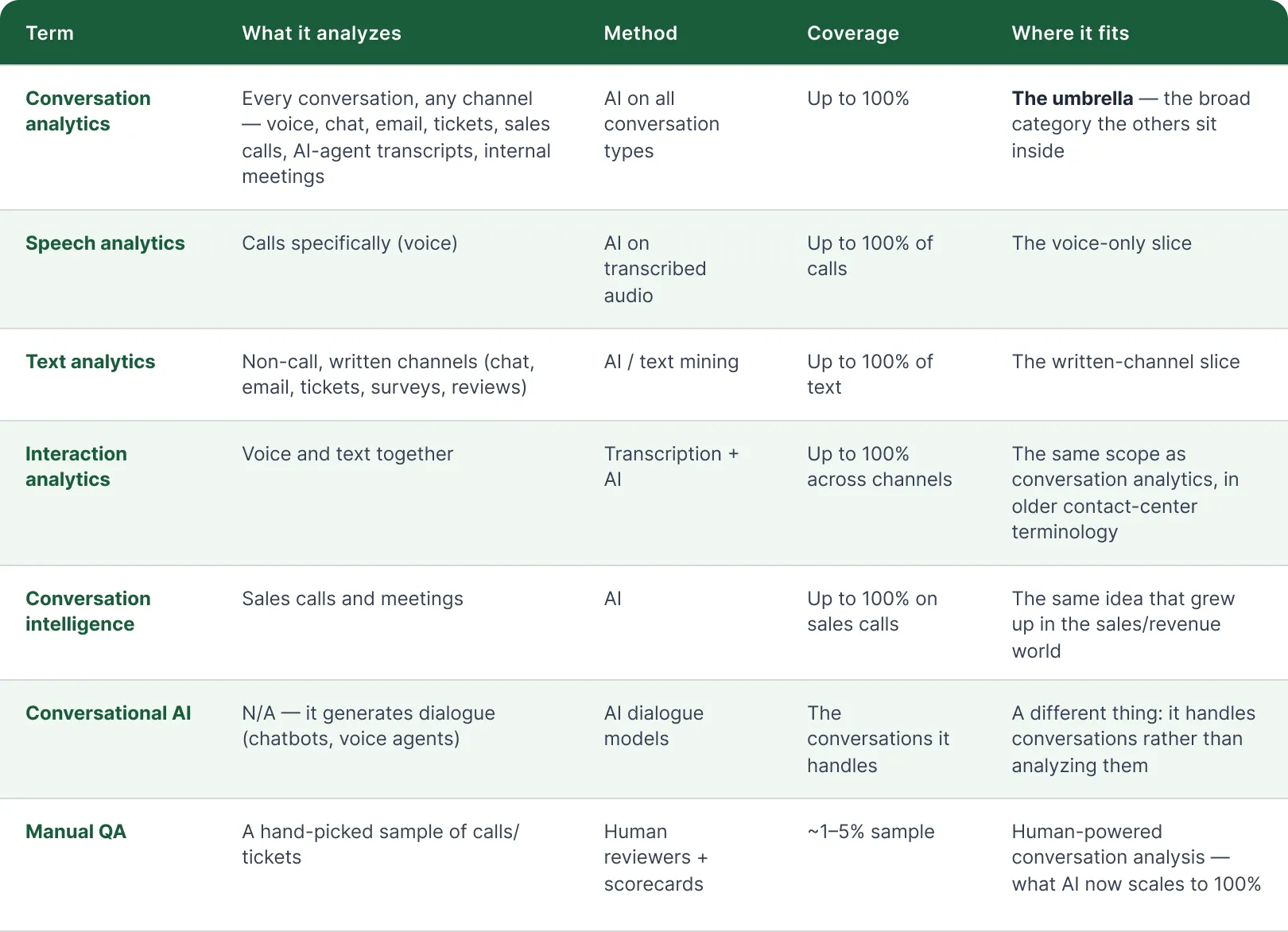
Conversation analytics is easy to confuse with adjacent disciplines — and with an unrelated category that happens to share the name. The table below draws the lines.

Two practical notes:
  1. 1
    Conversation analytics is the broadest of the customer-conversation terms

    Speech, text, and interaction analytics are effectively subsets, and it increasingly absorbs sales (conversation intelligence) and internal conversations too.

  2. 2
    ‘Conversational’ analytics is used for a different category

    Mind the spelling: "conversational analytics" (with the -al) is also used for a completely different category — natural-language business intelligence, where users "ask their data a question" in plain English. That's not what this guide covers.

Conversation analytics is expanding beyond the contact center

Conversation analytics started as a contact-center discipline — but the definition is widening to cover every conversation a business has. For most of its history, "conversation analytics" meant one thing: mining support calls and chats inside a contact center to score quality, surface compliance risks, and track customer sentiment. That's still the core. But it's no longer the whole picture.

Three new surfaces are pulling the category outward:
  • Customer-to-AI conversations. As AI agents and chatbots handle a growing share of frontline interactions, every one of those exchanges is a transcript that needs to be analyzed — for accuracy, containment, escalation, and brand safety. This is a brand-new conversation surface that barely existed two years ago.
  • Sales conversations. Revenue-intelligence tools like Gong and Chorus proved that the same analytics applied to support calls deliver outsized value on sales calls — coaching reps, spotting deal risk, and reading buyer intent.
  • Internal conversations. Team meetings, internal calls, and collaboration threads are now routinely recorded and transcribed, turning everyday work talk into another analyzable corpus.

What's driving the expansion is a structural shift: recorded and transcribed conversations are exploding. AI has made transcription cheap, fast, and ubiquitous, so far more conversation data now exists to analyze than ever before.

AI meeting notetakers are a clear signal — roughly 75% of professionals now say they use an AI note-taker in work meetings, and the AI meeting-assistants market is projected to grow from about $1.2B in 2025 to $6.28B by 2035 at an 18% CAGR. The underlying speech-to-text layer is scaling just as fast, with the AI transcription market forecast to grow from $4.5B (2024) to $19.2B (2034) at a 15.6% CAGR.

Conversation Analytics Use Cases

How do you build a Voice of Customer program from conversations?

A Voice of Customer (VoC) program turns unstructured conversations into a structured, queryable narrative for product, engineering, and marketing. Conversation analytics is the engine: it classifies themes across every channel, quantifies how often each issue appears, and lets non-CX teams self-serve answers instead of filing manual requests with the support team.

The need is almost always framed the same way — by someone hired specifically to build it. A fintech CS leader:

Part of me coming on board includes building out a voice of the customer program to take data we can translate, tell a story with, and get it back to our product, engineering, and marketing teams.

The day-to-day pain it solves is the manual scramble for answers. Another fintech leader:

I get like two to four DMs a day from people in product who are like, hey, what are customers saying about this? And right now it's relatively difficult for us to get to that specific feedback without a lot of very manual labor.

The unlock is quantification at scale — answering the question, "how many times over 30,000 conversations did this come up?" — instead of cherry-picking anecdotes. A real VoC program reports frequency and dollar-weighted impact, not vibes.

A corporate fintech platform runs exactly this kind of program in production: custom AI Classifiers categorize 100% of conversations into themes — onboarding friction, product gaps, sentiment drivers, competitor mentions — and the team coaches from insights across every conversation. As a QA analyst at a corporate fintech put it:

In years of doing QA, nothing like this came out of the process. Now, we're actually protecting customers and revenue.

How does conversation analytics reduce churn?

Conversation analytics reduces churn by detecting at-risk customers early — surfacing frustration, repeated issues, cancellation language, and falling sentiment across every conversation before the customer leaves. Instead of finding out at renewal, CX and CS teams get a churn-risk signal in time to intervene, especially in accounts no human is actively monitoring.

The math of modern CS makes manual monitoring impossible. As a B2B SaaS leader explained:

We have over 3,500 customers and 50 CSMs, so you can't talk to all of them. We need a really good way to know when someone's at risk.

A restaurant and small-business point-of-sale fintech (~2,000 employees) closed that loop end to end: it analyzed churned-account conversations to learn the early signals, then applies them in real time across all conversations — and wires the result straight into the CSM workflow. As a voice-of-customer program manager at a POS fintech put it:

Now when a risk signal goes off in the platform, there's a case automatically generated in Salesforce for our success managers to proactively engage with that client without them having to ask for it… that's been a game changer.

How do you transform agent coaching with conversation analytics?

Conversation analytics transforms coaching by grounding it in evidence from every interaction instead of a handful of sampled calls. It pinpoints the specific behaviors each agent should work on, attaches the real conversation examples automatically, and removes the hours supervisors spend hunting for them — so coaching shifts from anecdote and gut feel to patterns seen across 100% of an agent's work, and from box-ticking compliance to genuine skill development.

Supervisors are time-starved. An IoT/hardware company named the underlying constraint bluntly:

The number one complaint from our supervisors is: I don't have enough time to focus on quality, to focus on coaching.

And the goal is rising above pass/fail compliance. A fitness chain CX leader:

My north star is making sure my team can improve the level of service — not just from a box-ticking compliance perspective, but how do we coach those soft skills?

The toil this removes is concrete: supervisors typically spend 30 minutes to an hour prepping each coaching 1:1, manually pulling calls. With AI already analyzing every conversation and surfacing specific coaching points — the behaviors to reinforce or correct, plus the supporting examples — that prep collapses and the 1:1 starts with what to work on already identified.

Crucially, AI informs the manager's judgment rather than replacing it. AI never has 100% of the context — the manager pairs what AI surfaces with what they know about the agent, the customer, and the moment, then delivers the hyper-personalized coaching the data alone can't.

How does it classify contact drivers and contact reasons?

Contact-driver classification uses AI classifiers to automatically tag why each customer made contact — billing, shipping, a bug, a policy question — across 100% of conversations. It replaces manual disposition codes and after-call tagging, which are slow, inconsistent, and expensive, with accurate, queryable categories that reveal what's actually driving volume.

Manual tagging is both costly and unreliable. One team spent ~$72,000/year on manual contact-tagging alone — and agent-entered disposition codes are notoriously inaccurate because agents rush them at the end of a call.

Accurate contact drivers feed everything downstream: VoC reporting, staffing forecasts, self-service prioritization, and root-cause analysis. When you know exactly why customers contact you — and how often — you can fix the upstream cause instead of endlessly handling the symptom.

How does it find the root cause of CSAT and NPS drops?

Conversation analytics finds root cause by reading the actual conversations behind a CSAT or NPS movement and separating agent-driven factors from product, policy, and operational ones. Instead of guessing — or spending days manually reviewing DSATs — teams see why the score moved, attributed to the real driver rather than blamed on whoever happened to handle the contact.

Supervisors are time-starved. An IoT/hardware company named the underlying constraint bluntly:

When we dig into it, we realize the csat is low because, while it gets attributed to an agent, there's a lot of non-agent factors contributing to it.

The manual alternative is brutal. One CX leader spent a full week going through 200 DSATs just to explain a single CSAT dip. A fintech app team described the ongoing version:

We're spending quite a long time manually bucketing our CSAT, trying to determine if it's product, policy, or people… it's really hard to understand why CSAT is dipping.

Conversation analytics does that bucketing automatically — product vs. policy vs. people — across every conversation, so a dip is explained in minutes, not a week.

An e-commerce home-furnishings brand (~500 employees) is a textbook case. Returns were dragging down satisfaction, but the team couldn't see where in the journey the friction lived. As a senior quality data analyst at an e-commerce home-furnishings brand put it:

Returns were driving a huge share of our DSATs, but we had no way to see which part of the return lifecycle was causing the friction.

Tying AI dispositions to operational data gave them trustworthy attribution — and AI Classifiers now categorize 100% of conversations by journey intent, which led to 3 policy changes that improved retention:

Once we tied AI dispositions to our operational data in the platform, we finally had trustworthy insight into what was actually driving negative sentiment." — a senior quality data analyst at an e-commerce home-furnishings brand

How does it reduce compliance risk?

Conversation analytics reduces compliance risk by checking 100% of conversations against regulatory requirements — verifying required disclosures, flagging script deviations, and redacting PII (PCI card data, HIPAA health data, KYC/AML identity checks) automatically. In regulated industries where all correspondence must be monitored, sampling isn't just risky — it can be non-compliant.

For regulated firms this is non-negotiable. A trading/finance platform stated the mandate plainly:

There's a regulatory requirement to monitor all the customer correspondences and the calls.

Automated compliance monitoring typically covers:

  • PII redaction — automatic removal of card numbers (PCI), health data (HIPAA), and identity data inline before storage.
  • Required-disclosure checks — verifying mini-Miranda, recording notices, KYC/AML and FCA scripts were delivered.
  • Deviation alerts — flagging when an agent skips or fumbles a mandated step.
  • Audit-ready records — a defensible log across 100% of interactions, not a sample.

"Monitor all" is impossible by hand. This is one area where 100% coverage isn't an efficiency gain — it's the requirement.

How does it automate agent QA and scoring?

Automated QA uses AI to score conversations against your quality criteria across 100% of interactions — a leap from grading one call at a time. In practice, though, few teams fully automate their entire scorecard: some criteria stay manual because the data setup isn't there, the technology isn't reliable enough yet, or the judgment still needs a human. The winning pattern is hybrid — let AI grade what it can reliably judge across every interaction and surface the hot spots, then shift human reviewers from rote form-filling to targeted quality deep dives where they add the most value.

As an online insurer told us, with affection and exhaustion in equal measure:

Our analyst does an outstanding job but there is one of her. She deserves to sleep. She deserves a life. Not just to listen to everyone's calls consistently.

Automated QA scoring delivers:

  • Every interaction screened against the criteria AI can reliably judge — not just a sample.
  • Humans focused where they matter — reviewers move from grading everything to targeted deep dives on the hot spots AI surfaces.

A corporate fintech platform (FinTech, ~1,500 employees) rebuilt its entire QA program around this shift. The old process generated numbers without outcomes — as a senior operations director at a corporate fintech put it: "We were spending hours on QA every week, but it wasn't driving customer outcomes—it was just generating scores."

Once leadership saw automated QA at scale, they scrapped the old playbook:

After a quick preview, our COO stopped us and said, 'No more manual QA. Go deep into this platform—this is going to be incredible for us.' That was the catalyst to burn our QA playbook and rebuild it from the ground up." — a senior operations director at a corporate fintech

For the first time, the tooling exists to close that gap. The market reflects it: analysts size contact-center analytics alone at roughly $2.8B in 2026, growing about 20% a year — and that's only the contact-center slice of a much larger conversation-data universe.
Modes, Evaluation, & Reach

Real-time vs. post-conversation analytics

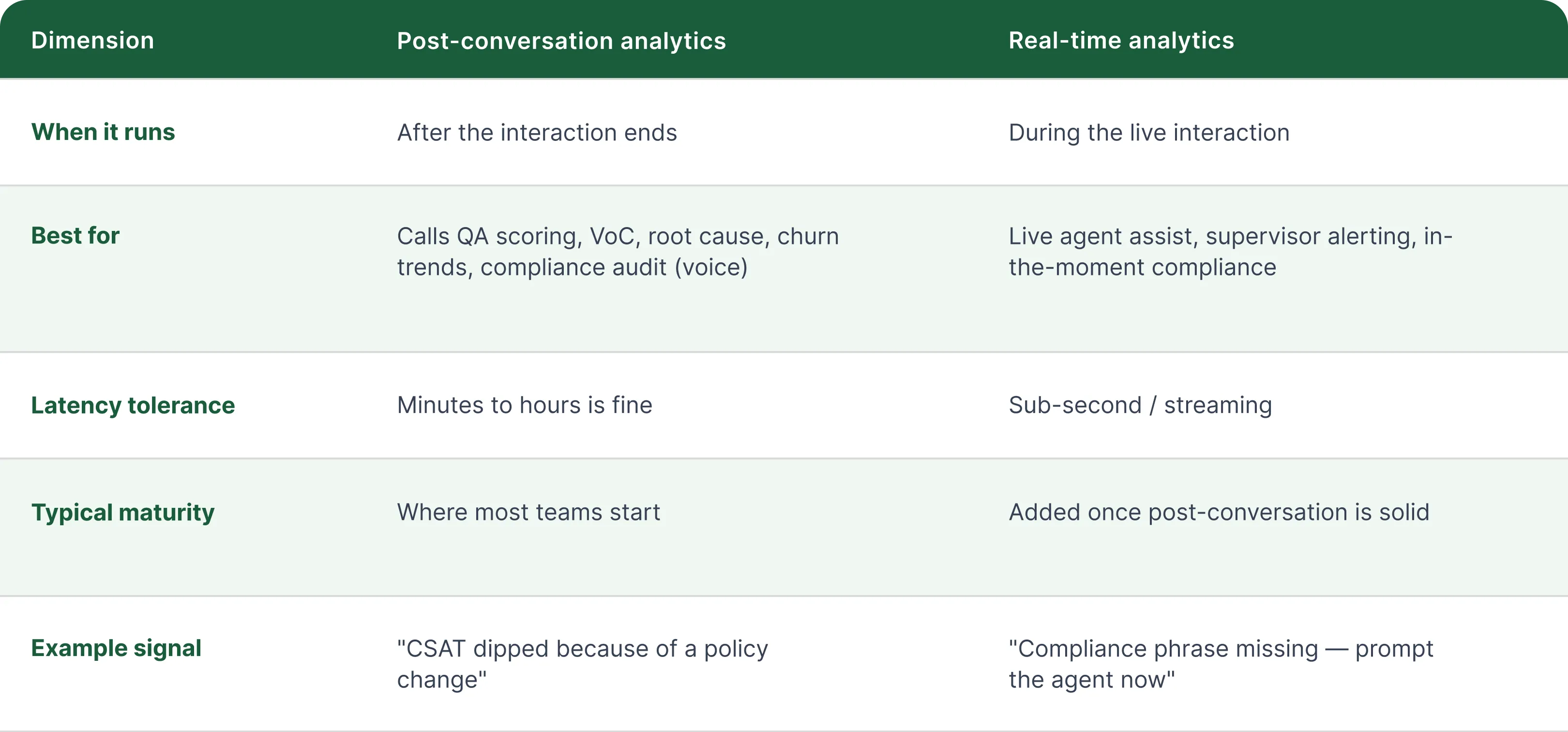
Conversation analytics runs in two modes. Post-conversation (post-interaction) analysis processes conversations after they end — ideal for QA scoring, VoC, trend analysis, and root cause. Real-time analysis runs during the conversation, powering live agent assist, supervisor alerts, and immediate compliance flags. Most programs start post-conversation and add real-time where the intervention is worth the engineering cost.

The "alerting and remediation layer" the insurtech leader described — catching an AI agent or human agent going off-script and intervening — is the real-time end of this spectrum.

How does it move beyond low survey response to predictive CSAT/NPS?

Conversation analytics replaces sparse surveys with predictive CSAT and predictive NPS — inferring a satisfaction score for every interaction from the conversation itself, even when no survey is returned. Since response rates are typically low single digits, surveys measure a biased fraction; conversation-derived scores cover 100% and remove that blind spot. Because it scores 100% of conversations, conversation analytics can reduce or replace reliance on expensive standalone survey programs.

The survey-coverage problem is stark and widespread:

  • One team sees a 2% response rate with 99% satisfaction — and, in their words, "no insight."
  • At a design-software company, CSAT covers only 14–15% of contacts.
  • A hospital runs 800,000 patient surveys a year with no AI to read the free-text comments.

Predictive CSAT/NPS fixes both the coverage gap (score everyone) and the comprehension gap (actually read the 800,000 comments). You get a satisfaction signal on the silent majority who never fill out a survey — which is exactly where churn hides.

A background-check and hiring-trust platform (B2B SaaS) went all the way: predictive CSAT now covers 100% of interactions versus roughly 7% with surveys, and it became the team's primary satisfaction metric. As a director of shared services at a background-check platform put it:

We still survey our customers, but we don't actually look at that. We look at this one hundred percent. And we report it all the way up to the C-suite.

How does it evaluate AI agents and chatbots?

As conversational AI handles more interactions, conversation analytics becomes the system that grades it — measuring containment, detecting hallucinations and off-policy responses, and scoring AI agents against the same rubrics used for humans. It provides the continuous observability and alerting layer that production AI agents need to be trusted.

Evaluating AI agents typically means tracking containment (did the bot resolve it without escalating?), accuracy (did it hallucinate or cite wrong policy?), and behavior (did it follow guardrails?) — across 100% of bot conversations, with alerts when it goes wrong. As more frontline conversations move to AI agents, this becomes a primary, not secondary, use case. Beyond containment and hallucinations, teams increasingly need production-grade observability — detecting logic errors, model bias, and decision drift, with alerting and remediation — as AI agents handle millions of interactions.

A B2C marketing-CRM SaaS does this in production: it runs AI across 100% of its bot conversations, which surfaced a lower escalation rate and higher true containment — the kind of measurement that turns a chatbot from a black box into a governed, improvable system.

How do you turn customer pain into prioritized product feedback?

Conversation analytics converts raw customer complaints into a ranked, dollar-weighted product backlog. Instead of prioritizing features by raw mention count, it ties each request to account value and churn risk — so product teams fix what actually protects revenue, backed by the verbatim conversations behind every theme.

The shift from "most mentioned" to "most valuable" is the maturity step. A logistics/data company described exactly this evolution:

For every one of those requests, we try to put a dollar value on it based off contract value, percent of risk… before, the only way we could prioritize was the number of mentions.

Mention count over-weights loud customers and under-weights silent, high-value ones. Dollar-weighting — joining conversation themes to CRM contract data — is what turns VoC from a report into a prioritization engine product and engineering will actually trust.

A background-check and hiring-trust platform (B2B SaaS) operationalized this with an "Atomic Problems" framework, where AI classifiers pinpoint specific issues rather than vague buckets. One billing-issue cluster surfaced a 47% predictive CSAT score and a 58% unresolved rate — concrete enough that it was escalated to the Chief Product Officer within days, exactly the kind of evidence product teams act on instead of debating.

Speed matters too. A B2C marketing-CRM SaaS analyzed a full month of conversations in roughly two hours to feed a product launch — and as the VP of global support at a B2C marketing-CRM SaaS describes the cadence shift:

Our product launch process is on an agile delivery cycle. The product team was running at a five minute mile, and we were running at a seven minute mile. What the platform has done is sped up the process so now we're all running a four minute mile.

What integrations matter?

The integrations that matter most are no longer just the contact center's — they're everywhere your conversations live. The real pain is fragmentation: conversation data is scattered across acquisitions, channels, and point tools — telephony, chat, AI agents, sales tools, meeting recorders, data warehouses, and separate systems for transcription, auto-QA, and surveys — that teams want consolidated into one analytics layer.

A conversation analytics platform is only as good as the data it can reach, so breadth of integration has become the single biggest differentiator: if a conversation happens somewhere you can't connect, it's a blind spot. The goal is a single analytics layer over all of it.

Here are the integration categories that matter:

Contact center / telephony
The foundation — voice interactions and call recordings from platforms like Genesys, NICE CXone, Five9, Talkdesk, Amazon Connect, and Aircall.
Meeting / internal conversations
Team calls and recorded meetings are now a routine data source. Integrations with Zoom, Microsoft Teams, Google Meet, Otter, and Fireflies turn internal talk into analyzable conversation data.
Helpdesk / ticketing
Where support chats, emails, and tickets accumulate: Zendesk, Intercom, Freshworks, Gladly, Gorgias, and Salesforce Service Cloud.
CRM & customer data
Conversations gain meaning when joined to who the customer is and what they're worth. Connecting Salesforce and HubSpot ties conversation insights to accounts, deals, and lifecycle.
Sales / revenue conversations
Sales calls carry the same analyzable signal as support calls. Connect revenue-intelligence and engagement tools like Gong, Chorus, Salesloft, and Outreach, plus the meeting platforms where deals happen — Zoom and Google Meet.
Data warehouse / BI
Enterprises want conversation insights flowing into the systems where they already report. Integrations with Snowflake, Databricks, and BigQuery feed the warehouse, while Looker, Tableau, and Power BI put the results in front of analysts and executives.
AI agents / chatbots
As AI handles more frontline conversations, those transcripts need the same scrutiny as human ones. Pulling logs from Intercom Fin, Decagon, Sierra, Ada, and Salesforce Agentforce lets you measure AI accuracy, containment, and escalation — a fast-growing, brand-new conversation surface.
AI / agentic layer
Increasingly, teams want to query conversation data directly from AI assistants. Support for MCP connectors and access from assistants like Claude and ChatGPT brings conversation analytics into the agentic workflows teams already use.

The principle is simple: conversation data is now everywhere, not just the call center — and the platform that can ingest, unify, and analyze all of it wins.

How do you evaluate conversation analytics solutions?

The fastest way to evaluate conversation analytics solutions is a head-to-head test on your own questions — and to pick the one whose answers you trust most. You don't need a months-long RFP. The method is simple:

Here are the integration categories that matter:

  1. 1

    Pick 3–5 real questions you actually want answered from your conversations — for example, "why did CSAT drop last week?", "which accounts show churn risk?", or "are agents delivering the required disclosure?"

  2. 2

    Ask each question twice. Consistency matters — a trustworthy tool gives you the same answer when you ask the same thing.

  3. 3

    Run every solution side by side and ask the same question in each at the same time.

Then judge the only thing that matters: which solution gives you the answers you trust the most?

Check whether each answer is backed by the actual conversations (verbatim evidence you can click into), whether it holds up across both asks, and whether it matches what you already know to be true. It's that simple.

FAQ

What is conversation analytics in simple terms?

Conversation analytics uses AI to automatically read and analyze every conversation a business has — calls, chats, emails, tickets, sales calls, AI-agent transcripts, and meetings — instead of a small human-reviewed sample. It surfaces what customers want, how they feel, how agents performed, and where risks are, across 100% of interactions rather than the typical 1–5%.

Is conversation analytics only for contact centers?

No — not anymore. Conversation analytics began as a contact-center discipline, but the category has widened to cover every recorded conversation a business has: support, sales, AI-agent/chatbot, and internal meetings. AI has made transcription cheap and ubiquitous, so far more conversation data now exists to analyze than ever before, and the analytics layer is following that data well beyond the call center.

Can conversation analytics analyze sales or AI-agent conversations?

Yes. The same analytics applied to support calls deliver outsized value on sales calls — coaching reps, spotting deal risk, and reading buyer intent. And as AI agents handle more frontline interactions, conversation analytics is increasingly the system that evaluates those bot transcripts for accuracy, containment, escalation, and policy adherence.

How is conversation analytics different from speech analytics?

Speech analytics analyzes voice calls only, traditionally via keyword and phrase spotting on transcribed audio. Conversation analytics is broader: it covers all channels (voice, chat, email, tickets, sales, AI-agent, internal) and uses AI to understand context and intent, not just match keywords. Speech analytics is essentially a voice-only subset of conversation analytics.

Is conversation analytics the same as conversational AI?

No. Conversational AI holds conversations — chatbots and voice agents that talk to customers. Conversation analytics analyzes conversations — scoring quality, detecting sentiment, and surfacing trends. They're complementary: conversation analytics is increasingly used to evaluate how well conversational AI agents perform in production.

Can conversation analytics really analyze 100% of interactions?

Yes. That total coverage is its core advantage over manual review: QA samples reach only ~1–5% of interactions, and surveys reflect only the few percent of customers who respond.

How does conversation analytics help reduce churn?

It detects churn signals — falling sentiment, repeated issues, cancellation language — across every conversation, flagging at-risk customers early enough to intervene. This is critical at scale: with thousands of customers and a finite CS team, conversation analytics surfaces the accounts that need attention before they reach renewal and leave.

Does conversation analytics handle compliance and PII?

Yes. It monitors 100% of conversations for regulatory requirements (PCI, HIPAA, KYC/AML, FCA), verifies required disclosures, flags script deviations, and automatically redacts PII. In regulated industries where all correspondence must be monitored, this full coverage isn't just efficient — it's often a legal requirement that sampling can't satisfy.

How much does conversation analytics cost?

Modern AI has dramatically lowered the entry point: you can start for as little as ~$100/month — or free on freemium plans — rather than the six-figure minimums legacy platforms once required. The biggest determinant of what you'll pay is your total conversation volume and how much AI analysis you run on top of it. Pricing models vary (per-seat, usage- or credit-based, or enterprise).

What is the difference between real-time and post-conversation analytics?

Post-conversation analytics processes conversations after they end — ideal for QA, VoC, root cause, and trend analysis. Real-time analytics runs during the live interaction to power agent assist, supervisor alerts, and in-the-moment compliance flags. Most teams start with post-conversation and add real-time where immediate intervention justifies the added complexity.

What is Voice of Customer (VoC) and how does conversation analytics enable it?

VoC is a structured program that turns customer feedback into insight for product, engineering, and marketing. Conversation analytics powers it by classifying themes across every conversation and quantifying how often each issue arises — answering "how many times across 30,000 conversations did this come up?" instead of relying on anecdotes.

What types of companies use conversation analytics?

Conversation analytics is used across many segments — fintech and payments (corporate fintech and POS/payments platforms), e-commerce and consumer brands (including home furnishings), B2B and B2C SaaS, marketing technology, background-check and hiring-trust platforms, healthcare, insurance, and travel.

How accurate is AI conversation analysis — and can I trust it on accents, sensitive industries, and multiple languages?

Accuracy depends largely on you. The biggest levers are how much effort you put into calibrating and updating the AI's prompts for your context, and your willingness to spend a bit more AI usage to double- and triple-check important work. It's trustworthy out of the box for many use cases — but every situation is different (accents, sensitive industries, languages), so verify it against your own conversations before you rely on it. Good platforms make that easy by showing the verbatim evidence behind every answer.

How does conversation analytics handle messy or incomplete data — transferred calls, missing transcripts, mislabeled speakers, multi-agent tickets?

100% coverage only matters if the underlying data is sound. Real failure modes include transferred calls that capture only seconds of a long conversation, missing transcripts, mislabeled speakers, and multi-agent tickets that confuse attribution. The good news is that AI is far more forgiving of messy data than rule-based tools — because it reasons about context, it can work around imperfect data and doesn't need everything to be clean. And in many cases the right conversation analytics platforms add a data-modeling layer that helps you fix those data issues over time.

How does conversation-analytics pricing work, and how do I keep AI/usage costs under control?

Pricing models vary — per-classifier vs. bundled, usage or credit-based, and per-seat. Buyers flag per-classifier pricing (e.g., ~$5,000 each) as un-scalable and worry about teams "blowing through" budget without visibility. Look for transparent usage tracking, governance controls, and bundled classifiers so cost scales with the value you get, not with the number of questions you ask.

How is conversation analytics different from just using ChatGPT or Claude — or building it in-house?

General assistants are great for ad-hoc reading but weren't built to operationalize conversation data at scale — they sample, miss frequency across all conversations, and can return "convincingly good-looking results that are wrong." DIY builds on a data warehouse are hard to maintain and rarely give the full picture. A purpose-built platform provides repeatable classification across 100% of conversations, auditable evidence, and governance.

How do BPOs and outsourced support teams use conversation analytics?

BPOs use it to give clients trend and Voice-of-Customer insight instead of manual reporting. Brands that use multiple BPOs use it to compare performance across vendors on a consistent rubric and turn findings into coaching across offshore teams — comparisons generic helpdesk-QA tools can't do. The result is a shared, evidence-backed view of quality that works across vendor boundaries.

Conclusion

Conversation analytics has moved from a nice-to-have reporting layer to the operating system of modern CX — and it's no longer confined to the contact center.

The story is a shift on two axes:

  1. 1

    From keyword-based analysis to AI-powered understanding

  2. 2

    From the contact center to every conversation a business has

The enabling math is simple: humans can read 1–5% of conversations and surveys reach only a few percent of customers; AI reads 100%. That difference is what lets teams build a real Voice of Customer program, catch churn early, classify why customers contact them, coach agents with evidence, automate QA, evaluate AI agents, and prove compliance — across support, sales, AI-agent, and internal conversations alike.

This isn't theoretical: real customer deployments — across fintech, e-commerce, and SaaS, among other segments — are already running these plays in production, from 100% predictive CSAT to automated churn signals to dollar-weighted product feedback.

If your team is still QAing a 3% sample, relying on single-digit survey response rates, manually bucketing CSAT, or downloading tickets into ChatGPT by hand, the gap between what you can see and what's actually happening is the opportunity

See how a conversation analytics platform can score 100% of your conversations →

Table of Contents

Get the ebook

Formatted for sharing with your team.

Share this post

Unlock Conversation-Powered AEO

Rippit finds the questions your customers actually ask, so you can write the answers AI engines cite.

All things are one. When we perceive this, we see that the flowers, the trees, and the stars are all part of our own body."

Where conversations become

insights

actionable data

business intelligence

enterprise visibility

insights

I fear not the man who has practiced 10,000 kicks once, but I fear the man who has practiced one kick 10,000 times
Peloton
legal zoom