Brex, SpotOn and Checkr use Rippit to read their customer conversations, turn what customers say into a consistent signal, connect it to account and business data and send it to a named owner. Brex reaches at-risk customers within hours. SpotOn opens a Salesforce case within an hour of a churn signal. Checkr ranks product problems by how much they hurt satisfaction and churn.
Customer conversations contain early evidence of churn, competitor pressure, product friction and expansion interest. The hard part is not proving that the evidence exists. It is finding it consistently, connecting it to the affected account and routing it to someone who can act while the signal still matters.
Key takeaways
- Start with one consequential question, such as which accounts show new churn risk, not a request to “find insights.”
- Create the judgment your systems don’t store. No CRM field says “this customer is looking at a competitor.”
- Connect the signal to the account, using CRM, warehouse and usage data, so the owner knows what is at stake.
- Keep the customer’s words attached so the owner can check why a signal fired.
- Give every signal an owner and a response time. A finding without an owner is just analysis.
What do the three workflows look like side by side?
Each company asks a different question, but all three end with a named owner acting on evidence.
| Company | The question | Data connected | Who acts | Result (from the customer story) |
|---|---|---|---|---|
| Brex | Which customers are at risk, and which competitor is reaching them? | Every support ticket | Team leads and managers; leadership every two weeks | Churn risk in 2 to 3% of tickets a week; outreach within hours |
| SpotOn | Which accounts show the signals churned accounts showed? | Salesforce, Gong, Zoom, support and Snowflake | Success managers, through a Salesforce case | Case opened within an hour of a signal |
| Checkr | Which customer problems hurt satisfaction and churn most? | Customer conversations and Snowflake account data | Product leadership and executives | Billing problem taken to the Chief Product Officer with customer evidence |
Brex, SpotOn and Checkr use Rippit in different ways, but their stories share the same operating pattern:
- read the relevant customer conversations;
- create a consistent judgment from what the customer said;
- connect the signal with account or business context;
- preserve the evidence;
- deliver it to a named owner or decision process.
Together, the examples show why growth data is more useful than another dashboard of conversation themes.
How does Brex catch churn risk and competitor moves while they’re happening?
Brex reads every support ticket for churn risk and reaches customers at direct risk within hours.
Brex uses Rippit to read every support ticket in the connected scope for churn risk and satisfaction.
According to Brex’s customer story, 2 to 3% of tickets each week contain a churn-risk indication. Team leads or managers reach out to customers at direct risk, usually within hours of the case closing.
The same analysis also captures competitor context: which competitor appeared, why the customer was considering it and the customer’s own words. When a competitor began contacting Brex customers with an offer to switch, the pattern showed up in support conversations. Brex reported seeing ten of those offers in one week, enough to confirm that the move was real and share it with the company’s competitive-intelligence channel.
Brex uses support conversations to surface churn risk and competitor activity. In this walkthrough, follow a sample ticket from a customer’s mention of a competing offer to the evidence a team lead can review before reaching out.
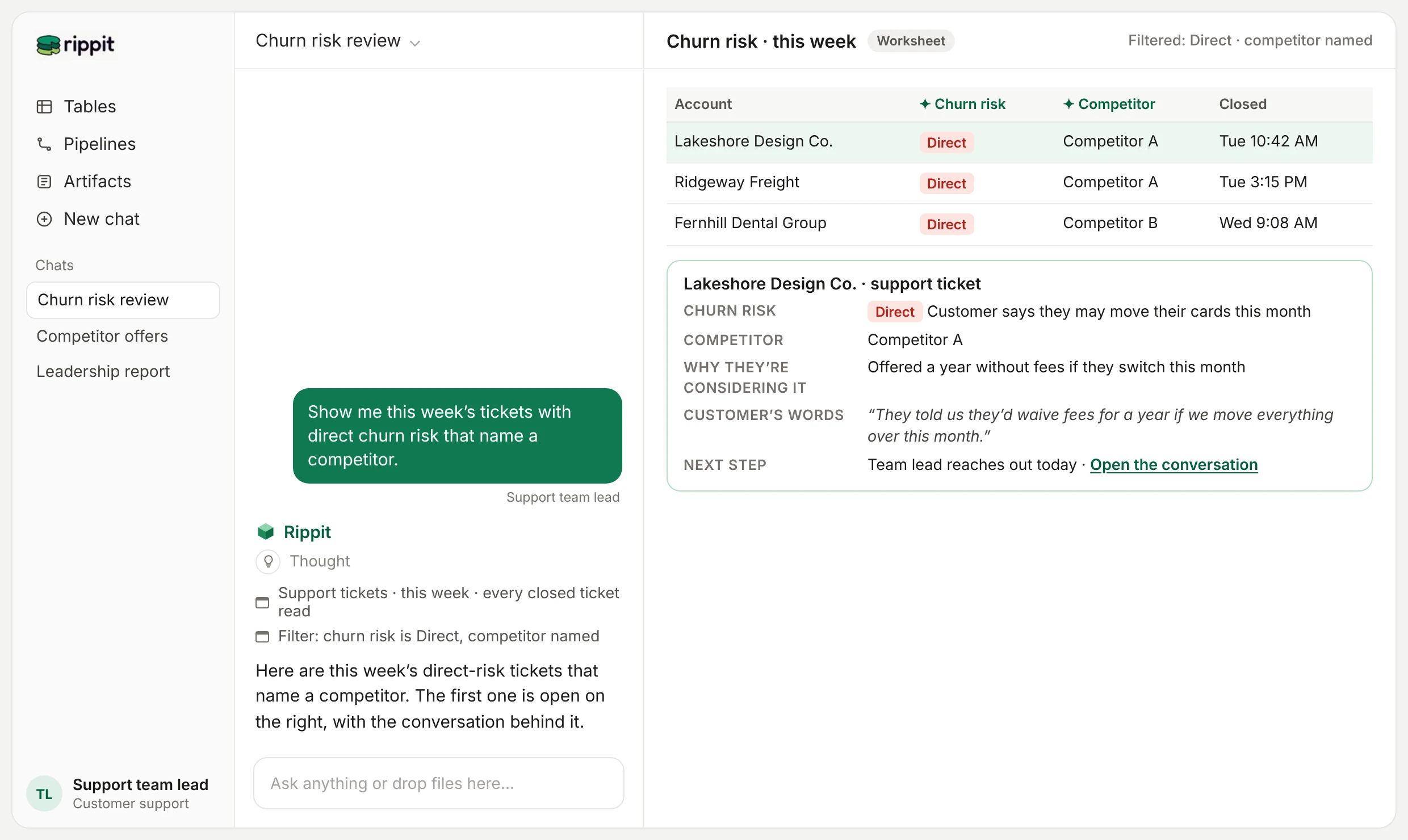
Every two weeks, a churn-risk report reaches leadership. The report includes what happened, why it matters and the customer’s exact words behind each case.
The important lesson is not simply “classify tickets.” Brex turned a classification into an operating loop: detect, review, contact and learn. The ready-made versions are the Renewal Risk Watch and Competitor Threat Alert agents.
How does SpotOn turn a churn signal into an owned Salesforce case?
SpotOn learned its churn signals from two years of churned accounts, and each new signal opens a Salesforce case for the success manager within an hour.
SpotOn connects CRM, sales, support and warehouse data in Rippit.
The company began by looking at two years of churned accounts across Salesforce, Gong and Zoom. The analysis created a timeline for each account and helped the team identify where trouble began. Those patterns became signals that could run on new account activity.
When a signal fires, a Salesforce case is created for the success manager within an hour, including the customer quote that triggered it. The quote gives the owner evidence to review before reaching out. In this walkthrough, follow a sample signal into the case to see how the triggering conversation and the next step reach the owner.
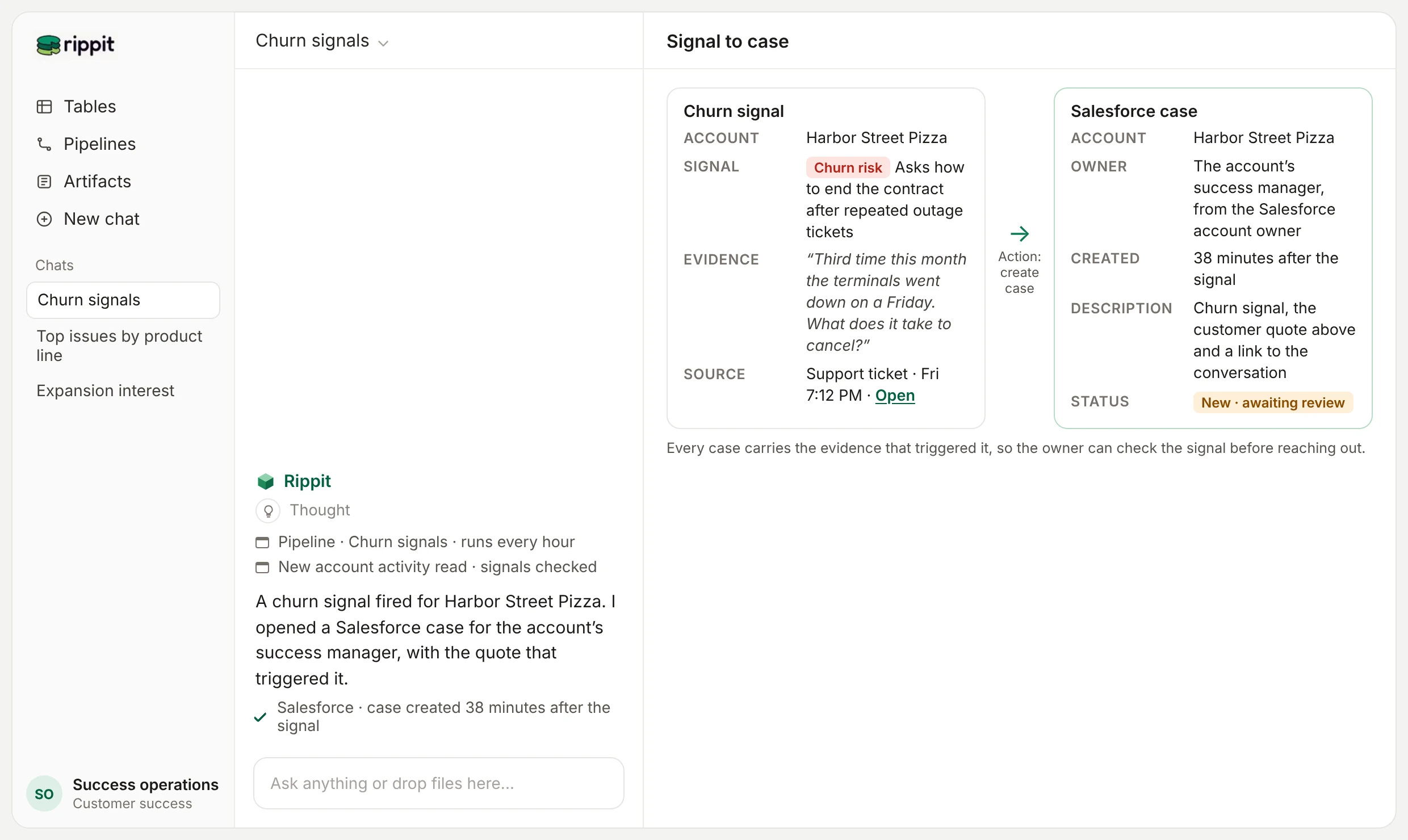
SpotOn also uses the same customer data for product priorities and growth. The team reports the top customer issues by product line and studies what excites new prospects in early sales conversations so success managers can introduce relevant products to existing customers.
This is what makes the workflow more than churn detection. The underlying growth data supports retention, product and expansion questions without rebuilding the customer from scratch for each one.
SpotOn’s customer story reports that its customer-defined resolution rate is up about 2% a month. That is SpotOn’s observed result in its own workflow, not a universal outcome another company should expect.
How does Checkr rank product problems by their connection to churn?
Checkr scores every recurring customer problem by satisfaction and resolution, then joins conversations to warehouse data to find what drives churn.
Checkr serves about 120,000 customers. About 75% of its roadmap items used to go to its top 20 customers, while problems affecting the broader customer base were harder to rank.
With Rippit, Checkr reads customer conversations, joins them with warehouse data and organizes recurring issues into what the team calls Atomic Problems. Each problem is evaluated using customer satisfaction and whether the issue was resolved.
The analysis surfaced billing as a significant problem: about 600 tickets with a 47% predicted satisfaction score. Customer evidence revealed several distinct issues underneath the broad billing label. The team brought a focused report to the Chief Product Officer identifying the specific theme most likely to improve churn.
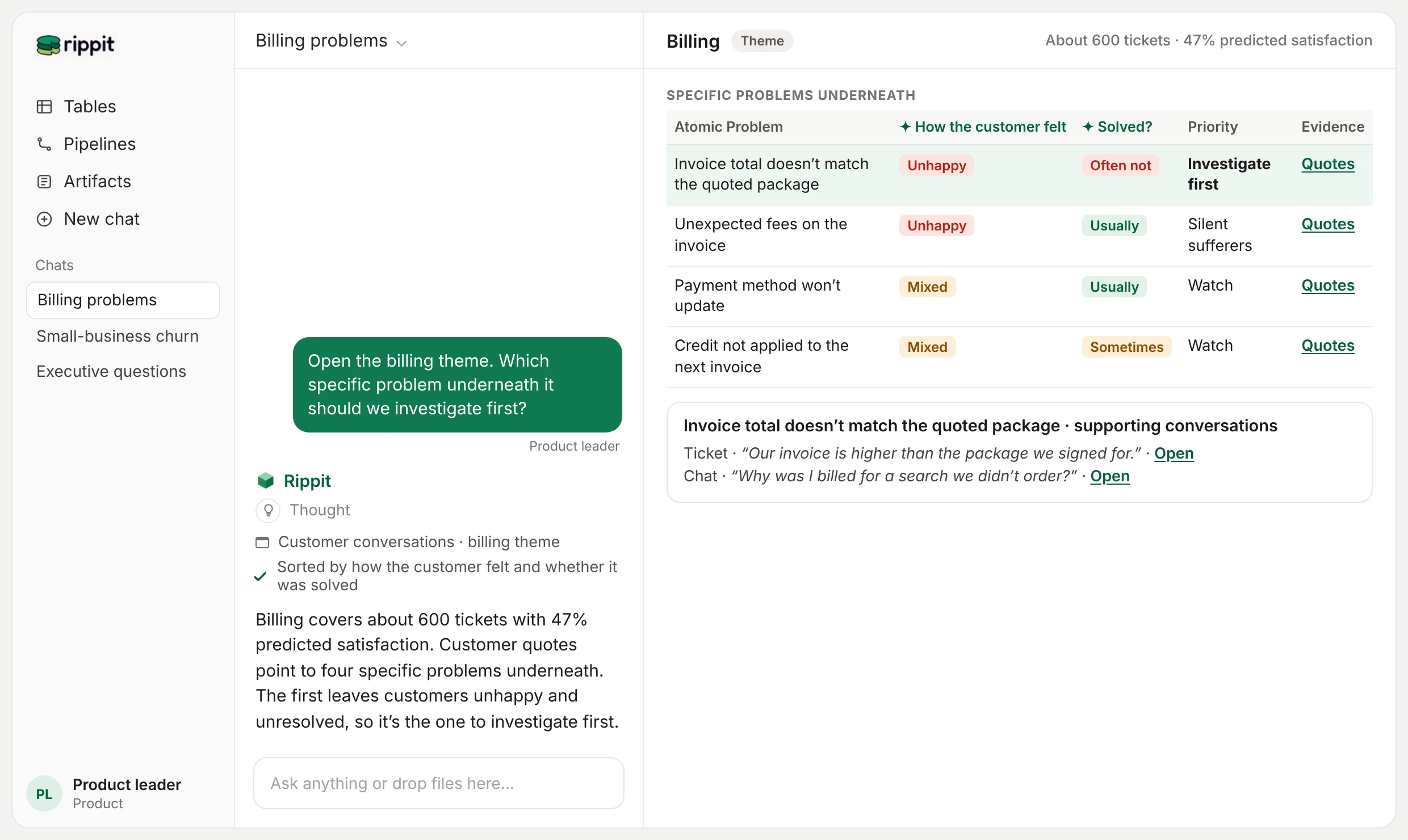
For small-business churn, Checkr’s structured data alone had not provided a clear answer. An analyst connected Snowflake account data with customer conversations to identify the missing explanation. The resulting evidence reached leadership and fixes are now on the product roadmap.
Checkr also uses the workflow to answer urgent executive questions. Its customer story describes a late-night CEO question about driving records in one state; the team produced a detailed report by the next morning and confirmed there was a real problem.
The lesson is that conversation evidence becomes more valuable when it is joined to the customer, product and outcome context needed to prioritize it.
What do the three workflows have in common?
Each one creates a judgment no system stored, ties it to an account and an owner, and keeps the customer’s words attached.
They create a judgment that did not already exist
The CRM did not contain a reliable field for “this customer is actively considering a competitor.” The helpdesk did not contain a complete ranking of product problems by their relationship to churn. Those judgments had to be created from the source evidence.
They connect the signal to an owner
Brex routes churn findings to managers and leadership. SpotOn opens a case for the responsible success manager. Checkr brings prioritized evidence to product and executives.
A finding without an owner is analysis. A finding with an owner, evidence and a next decision becomes a workflow.
They preserve the customer’s words
Each story emphasizes the importance of being able to inspect the conversation behind the classification. Evidence increases trust and lets a reviewer correct the model when it is wrong. SpotOn’s team, for example, logs misclassifications and updates its AI columns every Friday.
They combine structured and unstructured data
Conversation data explains why. CRM, warehouse and operational data establish which account, product, renewal or outcome is involved. The combination creates growth data neither source contains alone.
They keep human judgment where responsibility lives
Rippit finds and organizes the signal. People decide how to contact a customer, change the product or interpret the commercial consequence.
How do you build a similar workflow?
Start with one consequential question, describe it to Rippit in plain language and test it on a sample before it runs every day.
Start with one consequential question, not a generic request to “find insights.”
Examples:
- Which accounts show new evidence of churn risk?
- Which competitor offers are appearing in active customer conversations?
- Which product problem is affecting the most customers approaching renewal?
- Which expansion requests have enough account and usage context for a CSM to review?
Then define:
- the eligible population;
- the source conversations and business records;
- the judgment the workflow must create;
- the evidence a reviewer needs;
- the account or customer join;
- the owner and response time;
- the action that requires human approval;
- the outcome used to evaluate the workflow.
In Rippit: Describe the question in plain language. Rippit works backward to the sources, AI columns, lookups and rollups it needs, tests the pipeline on a sample and keeps it running after you approve it. An action can post to Slack or, through an enabled connection, open a CRM case.
Ask Rippit
Every morning, check yesterday’s support tickets and CS calls for churn risk or a competitor offer. Match each one to its Salesforce account and renewal date. Send the account owner a Slack message with the customer’s quote and a link to the conversation.
How should you measure the workflow?
Measure whether signals are right, reach an owner fast and lead to follow-up, not how much revenue they touched.
Useful measures include:
- signal precision after human review;
- population and source coverage;
- time from signal to an accountable owner;
- owner follow-up rate;
- repeated false positives;
- changes in resolution, retention or expansion outcomes among reviewed cases;
- reviewer corrections and model changes.
Do not label all revenue associated with a flagged account as revenue saved or at risk. A signal creates an opportunity to intervene; it does not prove what would have happened without the intervention.
What’s the pattern behind the customer stories?
Brex, SpotOn and Checkr are not running the same playbook. They are applying the same architecture to different growth questions.
Connect the customer’s words with business context. Construct the judgment the decision needs. Preserve the evidence. Put the result in front of the person who owns the outcome. Keep the work running long enough to learn whether it helps.
That is the difference between analyzing conversations and building a growth-data workflow. For a step-by-step version of the churn workflow, see how to build a churn radar.
Frequently asked questions
Does Rippit automatically contact at-risk customers?
No. In these customer stories, Rippit routes evidence to people or approved systems, such as a Salesforce case for a SpotOn success manager. Customer outreach and other consequential actions stay with your team, under your company’s permissions and process.
Do all three companies use Rippit for expansion?
No. The public stories show different combinations of churn, competitor, product, leadership and growth workflows. SpotOn’s story contains the clearest expansion example: success managers bring products that excite new prospects to existing customers.
Can these results be expected at another company?
No. The figures are attributed results from the named customer stories. Outcomes depend on data, implementation, operating process and customer population.
Why is the source conversation important?
The source conversation lets the owner verify why a signal fired, understand the customer’s context and correct the underlying model when necessary. Without it, a churn flag is a label nobody can check.
What is Rippit?
Rippit is a Growth Data Platform that helps you and your team build your edge. Anyone can build AI agents on all of their customer and business data, with no engineer needed. Read every conversation, connect it to your CRM, warehouse and usage data, and get each signal to the person who owns it. Keep the analysis running for your team, in Rippit or in the AI assistant you already use through our MCP server.
For this agent
- Reads
- Support tickets and sales and success calls from Zendesk, Intercom and Gong
- Joins
- Salesforce accounts and usage or warehouse data from Snowflake
- Delivers
- Each signal to the person who owns it, such as a Salesforce case for the success manager or a churn-risk report for leadership
Build your first agent on your own customer and business data.
Start free with $10 in credits. No credit card or engineer needed.
Sources
Keep reading
More from the Rippit Library.
Native Copilot, Direct MCP, Warehouse or Growth Data Platform: What Should Power Your AI Agent?
When to use a native copilot, direct MCP, a warehouse or a Growth Data Platform to power an AI agent, with a decision table and a five-question test.
Spot Renewal Risk Before It Threatens Revenue
Detect churn signals across conversations, usage and renewal data, backtest them, and route each at-risk account to the CSM and the team that owns the cause.
The Churn Signals Hiding in Tickets and Calls
Five signal families, a severity-and-persistence score, and what to do when a champion leaves.