Use a native copilot when the job stays inside one application. Use direct MCP when an agent needs controlled access to a small number of live tools. Use a warehouse when governed data and custom engineering are the center of the solution. Use a Growth Data Platform when several teams need shared growth data, reusable judgments and their own recurring agents.
Ask an agent connected to your CRM why deals were lost last quarter and it will search a few records and answer confidently. Ask a second agent the same question next week and it may pick a different time range, read different calls and define “lost” differently. The model isn’t the problem. What powers it is.
Many production systems combine the four options. The mistake is treating them as interchangeable.
Key takeaways
- Start with the narrowest option that fully supports the job and its controls.
- A native copilot is often the right first choice when the work lives in one app.
- MCP gives an agent reach, not shared meaning. Each agent still decides what “churn risk” means.
- A warehouse gives you governed history, but you build the agent layer around it.
- A Growth Data Platform earns its place when several teams need the same judgments, kept current.
How do the four options compare?
Each option is best at a different job, and each has a different way of failing.
| Option | Best when | Main advantage | Main risk |
|---|---|---|---|
| Native copilot or native agent | The job is local to one system and its workflow | Deep product context and low integration distance | Narrow context and vendor-specific definitions |
| Direct MCP connections | An interactive agent needs live, permissioned access to a few tools | Flexible tool use without centralizing every record first | Each agent interprets the data its own way; fragile at runtime and hard to reuse |
| Warehouse plus custom stack | The company has mature data engineering and needs maximum control | Governed history, custom logic and broad analytical reuse | Engineering burden and a gap between data assets and usable agent operations |
| Growth Data Platform | Several teams need shared growth data plus their own recurring agents | Shared data, reusable judgments and agent workflows in one place | Claims can outrun what’s actually connected, so test your own sources |
When is a native copilot the right choice?
When the job lives inside one application and cross-system context wouldn’t change the decision.
A native copilot is often the correct first choice for drafting, summarizing, searching or acting within one application. It can inherit the application’s objects, permissions, interface and operational context.
Choose it when cross-system context would not materially improve the decision. Add another layer only when the job genuinely crosses boundaries or requires independent evaluation.
When is direct MCP enough?
When an agent needs live lookups or carefully controlled actions in a few tools, not a consistent answer across every record.
MCP can let a compatible agent discover and call approved tools exposed by external systems. That is valuable for live retrieval and carefully controlled actions.
But a connection is not a shared definition. If each agent independently interprets “customer,” “revenue,” “issue” or “resolution,” the organization gets fast access to inconsistent meanings. Direct MCP also requires attention to authentication, user consent, scopes, tool descriptions, runtime failures, rate limits, logging and approval for writes.
Use direct MCP for a bounded toolset or as an execution layer over governed models. For how the three data paths differ, see MCP vs. API vs. Bulk API.
When should you build on a warehouse?
When your company can own the engineering to turn governed data into an agent product.
A warehouse is often the strongest source for historical, joined, testable business data. It supports explicit transformations, access controls, snapshots, lineage and broad analysis.
It does not automatically provide agent-ready interfaces, evidence review, workspace workflows, evaluator operations or safe actions. Teams may need to build semantic models, retrieval services, schedulers, monitoring, review queues and user experiences around it.
Choose this route when the organization can own that product and engineering work.
When does a Growth Data Platform fit?
When sales, marketing, product, CS and executives need the same growth data and judgments, each with their own agents.
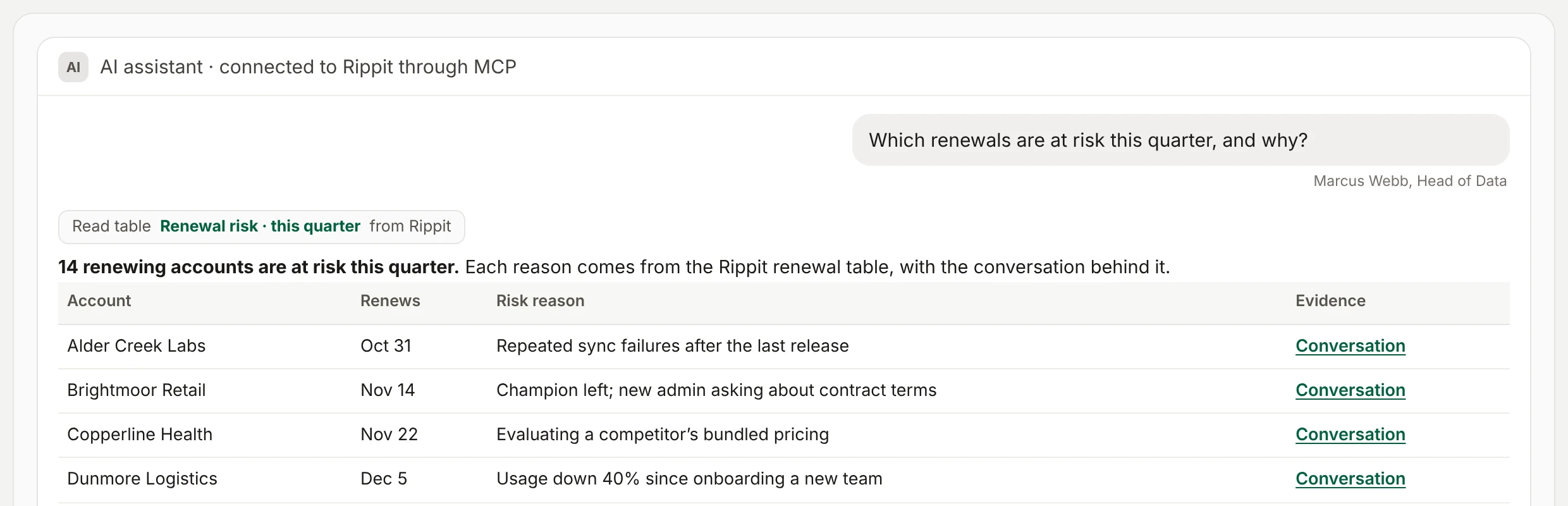
A Growth Data Platform fits when more than one team or agent needs to reuse the same finding. If CS uses a renewal-risk judgment for outreach and Product uses it to plan fixes, both should read one maintained judgment instead of rebuilding it in separate chats. It brings customer conversations, business records and market research together, turns them into reusable judgments and keeps agents working on them across sales, marketing, product, customer success, CX and executives. Shared data and judgments reduce duplication; individual workspaces let each team run its own questions and workflows.
The test is not whether the category sounds broad. Verify source coverage, identity, history, modeling, permissions, evidence, scheduling, evaluation, output destinations and human approval with your own data.
Data
Judgment
Answer
Action
How do you choose? A five-question test
Score the job on scope, freshness, shared definitions, control and who runs it after launch.
- Scope: Does the job live in one application or cross several systems and teams?
- Freshness: Does it need live tool access, governed batch history or both?
- Shared definitions: Where will shared definitions and reusable judgments live?
- Control: Who governs permissions, evidence, evaluation, approvals and audit history?
- Operations: Who owns failures, changes, costs and human review after launch?
If the answers differ by step, use a hybrid architecture deliberately. For example: warehouse history and account models, a Growth Data Platform for reusable agent workflows, native interfaces for users and MCP for approved live retrieval or action.
Where does Rippit fit, and where doesn’t it?
Rippit is the Growth Data Platform option, and it works alongside the other three rather than replacing them.
Data integrations bring calls, tickets, chats and CRM records into Rippit as tables, read-only with respect to the source. Snowflake tables and files join them. Pipelines add the judgments your systems don’t store, as AI columns, and keep them current.
Keep the AI assistants you already use. Connect Claude, ChatGPT, Gemini and more to the Rippit MCP server, and they work from the same tables and judgments, with each user’s own permissions.
Where it doesn’t fit: Rippit doesn’t replace your warehouse as the governed system of record, and it isn’t a copilot inside your helpdesk or CRM. MCP connections to other tools start read-only, and an admin enables each write tool, so test the exact sources and actions your agent needs.
So what should power your agent?
Start with the narrowest architecture that fully supports the job and its controls. Keep a native agent native when you can. Add MCP for bounded live tools, a warehouse for governed data engineering and a Growth Data Platform when cross-functional reuse and recurring agents justify the layer. For why connected agents still lack the judgments growth decisions need, see The Growth Data Your AI Agent Needs Doesn’t Exist Yet.
Frequently asked questions
Can I use more than one of these options at once?
Yes. Most production setups combine them: a warehouse for governed history, a Growth Data Platform for shared judgments and recurring agents, native copilots inside each app and MCP for live lookups or approved actions.
Is MCP enough to give an agent my company’s data?
MCP is enough when the agent needs a few current records or tools. When the question needs every record, a consistent definition or a result other teams reuse, the agent also needs data that has been joined, judged and stored before it asks.
Does a Growth Data Platform replace a data warehouse?
No. A warehouse stays the governed store for structured business data and can feed a Growth Data Platform. The platform adds conversations, reusable judgments and agent workflows that business teams can run without engineering.
Can I keep using Claude or ChatGPT?
Yes. Connect the assistant to Rippit through our MCP server and it reads the same tables and judgments as everyone else, limited to what the signed-in user can access in Rippit.
What is Rippit?
Rippit is a Growth Data Platform that helps you and your team build your edge. Anyone can build AI agents on all of their customer and business data, with no engineer needed. Connect conversations, CRM, warehouse tables and market research once, and give every team’s agents the same reusable judgments. Keep the analysis running for your team, in Rippit or in the AI assistant you already use through our MCP server.
How it fits
- Connects
- Helpdesk conversations and warehouse tables, such as Zendesk tickets and Snowflake account history
- Maintains
- Shared judgments, such as renewal risk, that every team’s agents reuse instead of rebuilding
- Serves
- Claude and other AI assistants through our MCP, plus Slack actions that reach the account owner
Build your first agent on your own customer and business data.
Start free with $10 in credits. No credit card or engineer needed.
Keep reading
More from the Rippit Library.
15 Knowledge Gaps Your AI Agent’s Conversations Can Reveal
Fifteen patterns in AI agent conversations that point to missing knowledge, context or workflow, how to confirm each one and who should own the fix.
The Growth Data Your AI Agent Needs Doesn’t Exist Yet
Why AI agents can’t find the judgments growth decisions depend on, and how to create them once as data every team can use.
Connect ChatGPT or Claude to Your Customer Conversations
Three ways to set it up, and which questions each one answers reliably: lookups, counts, judgments or trends.