Revenue intelligence helps sales teams run deals, pipeline, forecasts and coaching from sales calls and CRM activity. A Growth Data Platform puts customer, business and market data in one place so every team and its AI agents can create and reuse the judgments their decisions need. Use revenue intelligence for sales execution, a Growth Data Platform when the question crosses teams, and often both.
Revenue intelligence and a Growth Data Platform can both analyze sales conversations and CRM data. They are not the same category.
Revenue intelligence is designed primarily to help revenue teams understand deals, forecasts, pipeline activity and seller behavior. A Growth Data Platform connects customer, business and market evidence so sales, marketing, product, customer success, CX, executives and their agents can construct and reuse the judgments their decisions require.
The practical difference is the question each system is organized to answer.
Key takeaways
- Revenue intelligence is built around the deal, the rep and the forecast.
- A Growth Data Platform is built around the question, whatever team or source it needs.
- A CRM connection gives an agent fields, not the judgment behind the outcome.
- The two are often complementary. Many teams keep revenue intelligence for sales and add a Growth Data Platform for cross-team questions.
What is revenue intelligence?
Revenue intelligence software captures and analyzes sales activity so revenue teams can manage deals, pipeline and forecasts.
Revenue intelligence software helps revenue organizations capture and analyze information surrounding sales activity. Depending on the product, that can include calls, emails, meetings, opportunities, pipeline movement, forecasts, coaching and deal risk.
Typical questions include:
- Which deals are likely to close?
- Where is pipeline coverage weak?
- What objections appear in late-stage calls?
- Are sellers following the intended process?
- Which opportunities need manager attention?
- How accurately are teams forecasting?
The natural unit is usually the opportunity, seller, account or forecast period. The primary users are sales leaders, revenue operations, frontline managers and sellers.
What is a Growth Data Platform?
A Growth Data Platform turns customer, business and market evidence into findings that every team and its AI agents can reuse.
A Growth Data Platform connects customer conversations with structured business data and external market evidence, constructs missing business judgments from that evidence and keeps approved analyses running for people and agents across the company.
Typical questions include:
- Why are competitive deals being lost, and does the same issue affect renewals?
- Which product problems are spreading among high-value accounts?
- What buyer need appears in sales calls, support tickets and market research but is absent from current positioning?
- Which renewal risks changed this week, and what evidence supports each one?
- Which feature requests represent durable demand rather than a loud minority?
The natural unit can be an opportunity, account, conversation, product issue, competitor, campaign, agent, market question or recurring decision.
How do they compare side by side?
They overlap on sales calls and CRM data, and differ in who uses them, what data sits next to the calls and what the output is for.
| Dimension | Revenue intelligence | Growth Data Platform |
|---|---|---|
| Primary job | Improve sales execution, pipeline and forecasting | Create and use growth data across teams |
| Typical users | Sales, RevOps and revenue leadership | Sales, marketing, product, CS, CX and executives |
| Common starting data | Sales calls, emails, CRM and pipeline | Customer conversations, CRM, warehouse tables, product data, files and market research |
| Primary unit | Deal, account, rep or forecast | Any unit the decision needs: account, issue, product, segment or competitor |
| Missing judgments | Deal risk, next step, objection, forecast signal | Loss reason, product demand, renewal risk, positioning gap, issue severity and other company-specific judgments |
| Workflow | Inspect and act on revenue activity | Ask a business question, build what it needs and keep it running |
| Cross-team reuse | Usually centered on revenue workflows | Shared growth data with team workspaces and agents |
| External research | Varies by product | Can be part of the same recurring pipeline |
These are category-level distinctions. Individual products vary, and the categories can overlap. For a product-level comparison, see Rippit vs. Gong.
When is revenue intelligence the better fit?
When the job is fundamentally sales management and the evidence, operator and action all live in the revenue workflow.
Choose a revenue-intelligence platform when the job is fundamentally a sales-management job:
- forecast inspection;
- pipeline coverage;
- deal coaching;
- seller activity;
- call recording and review;
- opportunity risk;
- sales-process adherence.
If the evidence, operator and action all live inside the revenue workflow, a specialized platform is often the shortest path.
When is a Growth Data Platform the better fit?
When the question crosses systems, teams or business definitions.
Consider a Growth Data Platform when the question crosses systems, teams or business definitions.
For example:
Ask Rippit
Find opportunities lost to an implementation concern, check whether the same concern appears in support and renewal conversations, compare it with current competitor claims, and send product and product marketing the accounts, revenue context and the calls and tickets behind it.
That question begins with sales evidence but does not end there. It requires:
- calls and opportunity outcomes;
- a consistent definition of the implementation concern;
- support or success conversations;
- account identity across systems;
- competitor research;
- a cross-functional output;
- a recurring workflow that stays current.
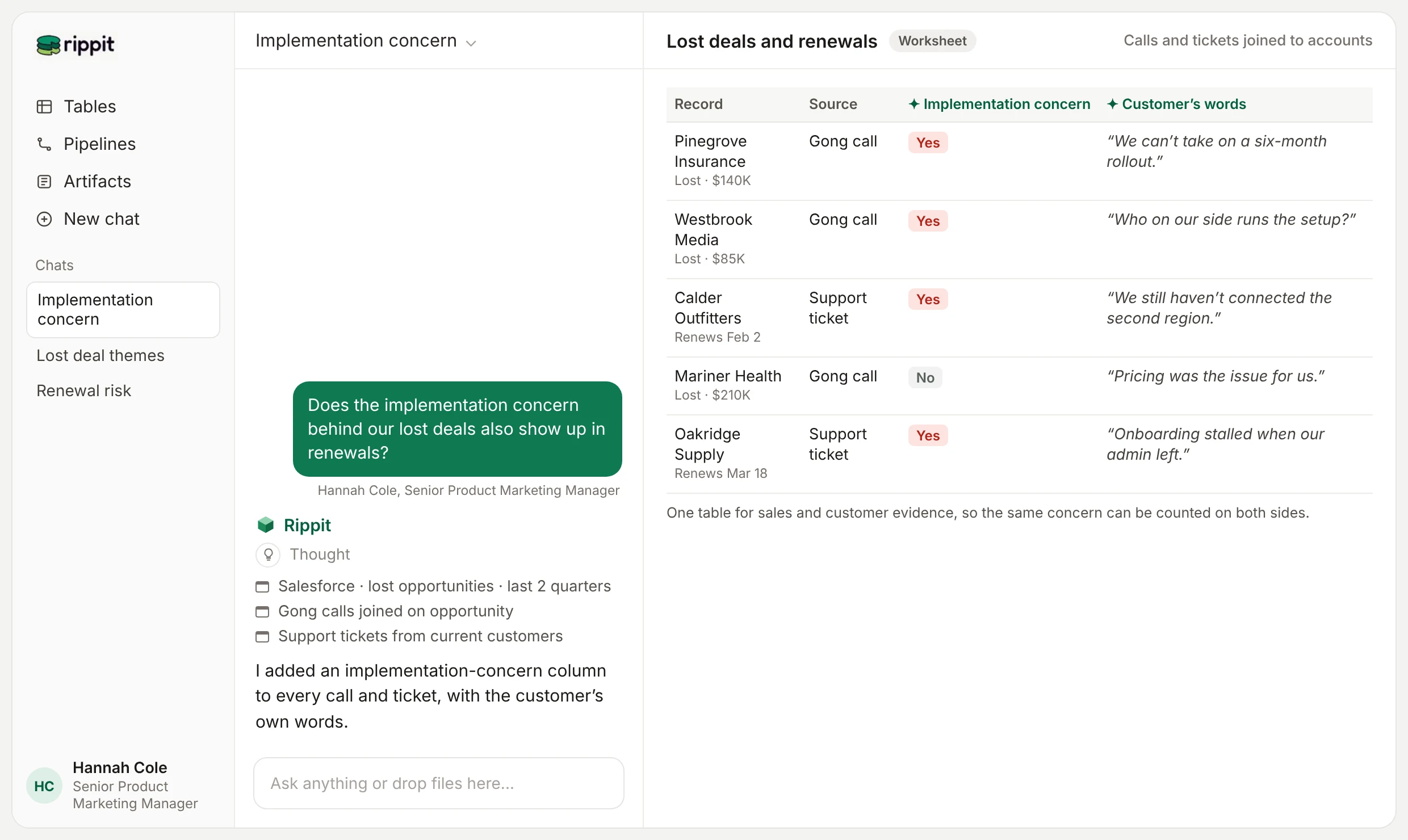
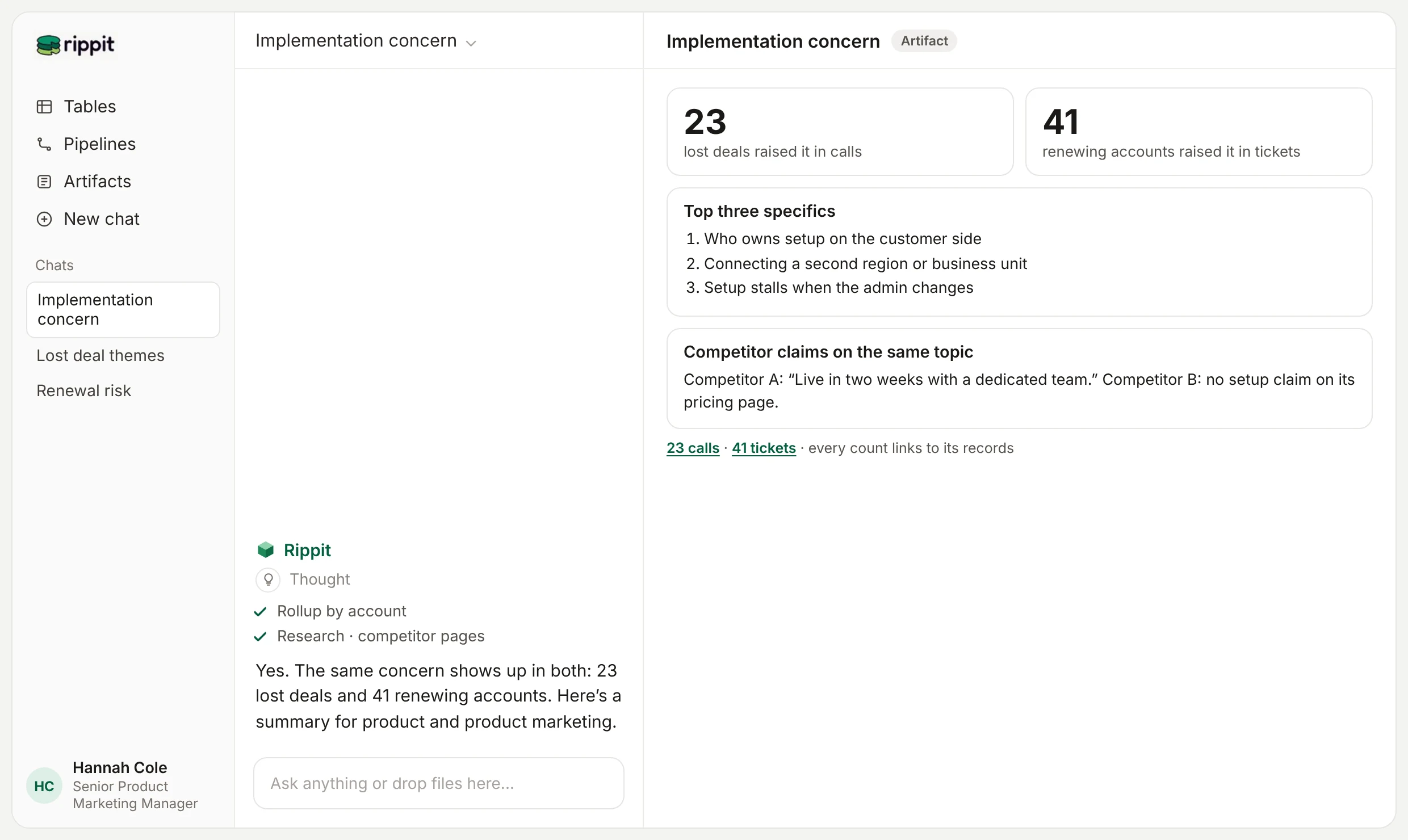
A revenue-intelligence platform may supply part of the evidence. The Growth Data Platform constructs the shared model that other teams and agents can build on.
Why isn’t a CRM connection enough?
A CRM stores the fields that already exist, not the explanation behind the outcome.
A CRM stores important structured facts: account, owner, stage, amount, close date and disposition. It rarely stores the complete explanation behind the outcome.
The real loss reason may be spoken across several calls. The buyer may describe one objection while the seller selects another dropdown. A later support ticket may reveal that the same concern was justified.
Connecting an agent to a CRM gives it access to the fields that already exist. It does not automatically create the missing judgment or apply it consistently across every eligible opportunity.
How can the two work together?
Keep revenue intelligence as the system for sales work, and let a Growth Data Platform reuse its calls alongside everything else.
The categories are often complementary.
A revenue-intelligence platform can remain the place where sales teams record calls, manage deals and coach sellers. Rippit can bring in calls from Gong and other call recorders, bring in Salesforce opportunity data as tables, connect other customer evidence and add market research.
A product marketer might ask:
Ask Rippit
What changed in competitive losses this quarter, and which product or messaging problem is responsible?
Rippit can work backward from the question to create the necessary AI columns, lookups and rollups. The revenue platform remains a source and system of work; the resulting growth data becomes reusable by product, marketing, CS and executives. To go further, see how to build a win/loss agent.
How do you choose? Five questions
Ask who owns the decision, which sources it needs, whether the judgment exists yet, who reuses it and what action follows.
1. Who owns the decision?
If the owner is a sales manager deciding how to progress a deal, start with revenue intelligence. If several functions need to use the same evidence differently, consider a shared growth-data layer.
2. Which sources are required?
List the minimum evidence. Do not choose a category before you know whether the question needs only sales activity or also support, usage, billing, research and product context.
3. Does the answer require a judgment that is not stored?
Fields such as “real loss reason” or “strategic demand” often have to be created from raw evidence. Determine where that judgment will be defined, reviewed and persisted.
4. Will another team or agent reuse the result?
If product, CS or marketing needs the same classification, do not trap it inside a one-time report.
5. What action follows?
Separate analysis, recommendation, delivery and write-back. Each needs an owner and appropriate permissions.
The bottom line
Revenue intelligence helps a revenue organization understand and improve revenue work. A Growth Data Platform helps the company turn its customer, business and market evidence into shared, reusable growth data.
Use revenue intelligence for specialized sales execution. Use a Growth Data Platform when the question crosses sources and functions, or when the company needs people and agents to build on the same maintained judgments.
In many companies, the right answer is both.
Frequently asked questions
Is a Growth Data Platform a replacement for Gong or another revenue-intelligence tool?
Not necessarily. A revenue-intelligence tool can remain the system for recording, reviewing and operating sales workflows. A Growth Data Platform can use that evidence alongside CRM, support, product and market data.
Can a Growth Data Platform forecast revenue?
Forecasting isn’t its primary job. A Growth Data Platform can produce evidence and signals relevant to a forecast, but specialized revenue-intelligence and planning systems may remain the better forecasting tools.
Does revenue intelligence use customer conversations?
Yes, especially sales calls and emails. The difference is not whether conversations are used; it is the organizational scope, surrounding data and decisions the platform is built to support.
What should buyers test?
Test the real business question using your own sources. Check coverage, identity resolution, historical context, evidence, permissions, repeatability and how the result reaches its owner. The Growth Data Platform buyer checklist has 30 questions to start from.
What is Rippit?
Rippit is a Growth Data Platform that helps you and your team build your edge. Anyone can build AI agents on all of their customer and business data, with no engineer needed. Bring in your sales calls from Gong and other call recorders next to support conversations, Salesforce and market research, and share the same judgments across every team. Keep the analysis running for your team, in Rippit or in the AI assistant you already use through our MCP server.
How it works
- Connects
- Gong calls and Salesforce opportunities, plus support conversations from Zendesk and Intercom
- Answers
- Questions that cross teams, such as whether the concern behind lost deals also shows up in renewals
- Delivers
- One shared finding for Sales, Product and Product Marketing, with links to every call and ticket behind it
Build your first agent on your own customer and business data.
Start free with $10 in credits. No credit card or engineer needed.
Keep reading
More from the Rippit Library.
What Data Should an AI Agent Have Access To?
Give an AI agent the minimum data its job needs: source evidence, IDs, business context, approved definitions and outcomes, with reads kept apart from writes.
Rippit vs. Gong
Revenue workflows on sales calls vs. all your growth data
Turn Buyer Intelligence Into Pipeline and Win Rate
Read buyer conversations next to CRM, win/loss, competitor and market data to find emerging demand, fix positioning that’s losing ground and measure the result.