MCP gives an AI agent access to your tools and records. Consistent judgment comes from what sits underneath: a defined population, stable IDs across systems, a versioned definition, results stored as data and a person who reviews and corrects them. Without those layers, two agents asked the same question can give two different answers.
MCP can let an AI agent reach your CRM, warehouse, helpdesk, documents and operational tools. It does not automatically teach the agent what your company means by churn risk, product demand, a qualified expansion signal or the real reason a deal was lost.
Access and judgment are different layers.
MCP solves an important access problem: a standard way for an AI client to discover and use tools. Consistent business judgment requires additional work: population definition, identity, evidence, shared definitions, persistent derived data, evaluation and ownership.
Key takeaways
- MCP gives agents reach, not your company’s definitions.
- More context doesn’t mean more consistency. Agents sample, match records differently and invent definitions.
- Five layers make judgment consistent: population, identity, a versioned definition, stored output and review.
- Store the judgment as data so every team and agent uses the same answer.
- Use MCP at both ends: for live lookups in, and for your assistant to read the finished data out.
What does MCP provide?
A standard way for an AI client to call tools in other systems, which gives the agent reach.
An MCP server exposes tools an AI client can call. Depending on the server and permissions, those tools might:
- search documents;
- retrieve CRM records;
- query a warehouse;
- inspect conversations;
- create a worksheet;
- post to Slack;
- update an approved system.
This gives an agent reach. It can gather current context and take actions without a custom integration for every client.
That is a major improvement over copying data into a prompt. But the agent still has to decide what to retrieve, how to interpret it and whether the available records represent the full question.
Which judgments do your systems not store?
The ones growth decisions depend on: why a deal stalled, whether a problem was solved, whether a request is real demand.
Many growth decisions depend on fields that do not exist yet:
- the buyer-stated reason a deal stalled;
- whether a customer’s problem was truly resolved;
- whether a competitor mention signals active evaluation;
- whether a feature request represents durable demand;
- whether several weak events add up to renewal risk;
- whether a messaging claim is resonating with the intended segment.
A CRM connection can provide the opportunity. A helpdesk connection can provide the ticket. A warehouse connection can provide usage. None necessarily contains the judgment the decision requires.
If the agent creates that judgment inside a temporary session, another agent may define it differently. The same agent may change its interpretation next week. The answer disappears without becoming organizational data. For how to create that data, see The Growth Data Your AI Agent Needs Doesn’t Exist Yet.
Why doesn’t more context guarantee consistency?
Because an agent with more access still samples, matches records its own way, defines terms as it goes and forgets its work.
An agent with access to more systems can still fail in predictable ways.
It retrieves a sample instead of the population
Thousands of records may exceed the practical scope of one agent session. The agent searches for relevant examples and then generalizes from what it found.
That can work for exploration. It is not a reliable basis for “how many,” “which accounts” or “what changed.” See why AI assistants sample, and when it changes the answer.
It joins records inconsistently
The same company may appear under several domains, account names or subsidiaries. Without a maintained identity model, the agent decides how to match records each time.
It invents the definition while answering
“Churn risk” can mean dissatisfaction, competitive evaluation, a cancellation request, usage decline or some combination. A prompt that does not specify the definition leaves a business policy decision to the model.
It loses the work after the session
Even a good answer may remain prose in one conversation. Other teams cannot filter it, correct it, compare it over time or build another agent on it.
What are the five layers behind consistent judgment?
A defined population, stable identity, a versioned judgment, stored structured output and review.
1. A defined population
Specify which records are eligible, which period applies and what is excluded. The population should be reproducible.
2. Stable identity
Use durable keys to connect conversations, accounts, opportunities, products and outcomes. Record unmatched and ambiguous joins rather than hiding them.
3. A versioned judgment
Define the classification, score or extraction in business language. Include positive examples, exclusions and the evidence required.
4. Persistent structured output
Store the result as a typed field or table that can be counted, filtered, joined and reused. Keep the source evidence attached.
5. Review and correction
Give an owner the ability to inspect examples, correct the model and evaluate whether the judgment remains useful as the business changes.
How does a Growth Data Platform complement MCP?
It creates and maintains the judgment before the next question is asked, and MCP lets any assistant use it.
A Growth Data Platform creates and maintains the data an agent needs before the next question is asked.
In Rippit, a person can begin with a business question such as:
Ask Rippit
Which competitive deals are at risk because buyers believe our implementation will take too long?
Rippit can work backward to:
- select eligible opportunities and conversations;
- create an AI column defining the implementation concern;
- look up opportunity and account context;
- roll the evidence up by opportunity or account;
- let an agent run investigate each material case;
- preserve the resulting table and sources;
- deliver or act through an approved connection.
MCP may participate at both ends. It can bring in a live lookup or let the assistant you already use query the finished growth data through the Rippit MCP server. The persistent pipeline provides the consistency.
What does the difference look like in practice?
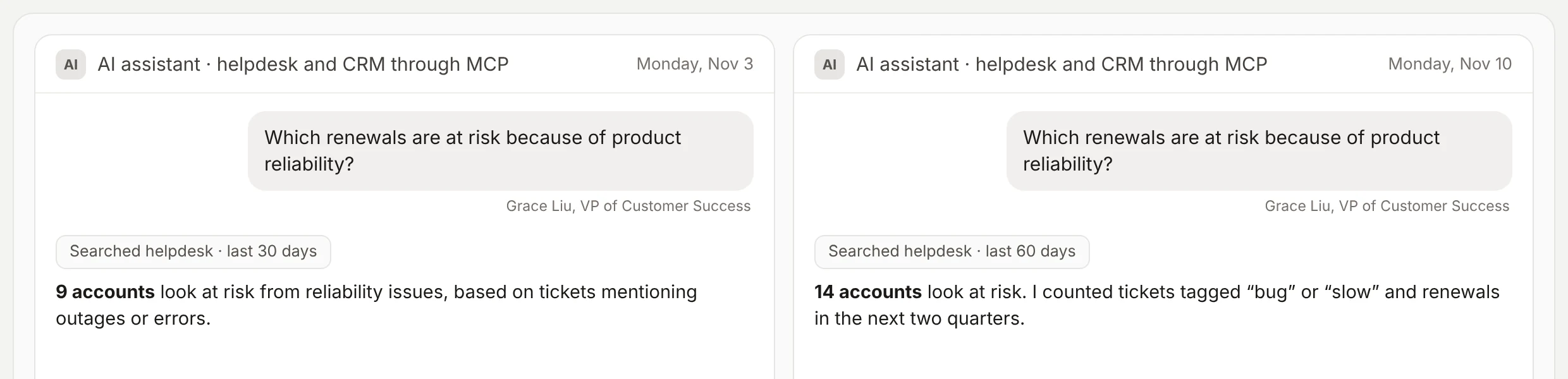
Two agents asked the same question a week apart give two answers, unless both read the same maintained table.
Imagine asking two agents, a week apart:
Ask Rippit
Which renewals are at risk because of product reliability?
With access alone, each agent may:
- choose different time ranges;
- retrieve different conversations;
- define reliability differently;
- weigh account value differently;
- omit accounts with no easily retrieved evidence;
- produce prose that cannot be compared.
With a maintained workflow, both use:
- the same renewal population;
- the same account joins;
- the same definition of reliability risk;
- the same typed output;
- the same evidence requirements;
- a visible model version and correction history.
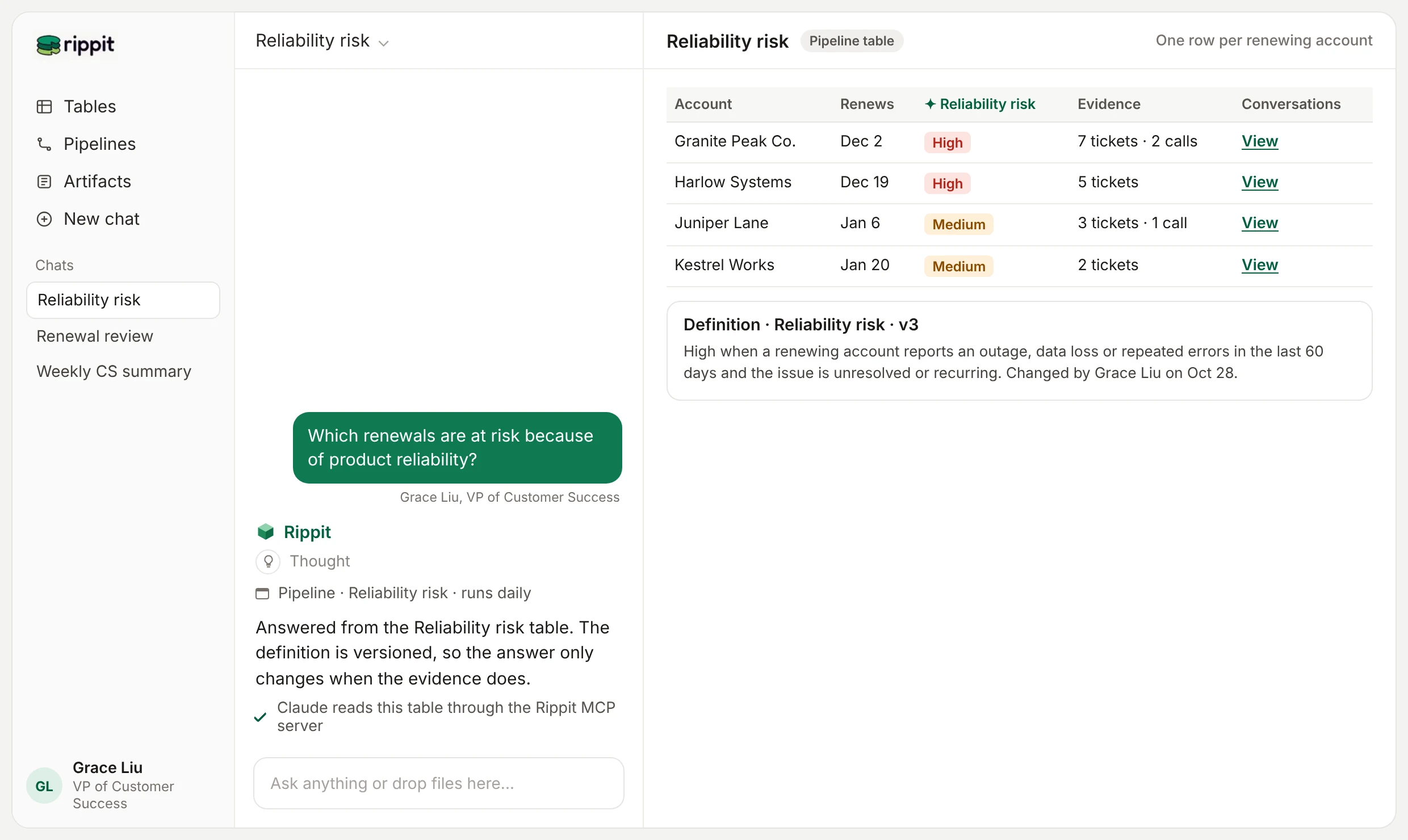
The model can still reason. It is reasoning on a stable foundation.
When is MCP alone enough?
When the question is about a few known records, the answer is low-stakes and nobody needs to reuse it.
MCP-only access may be sufficient when:
- the question concerns one or a few known records;
- the answer does not need population-level completeness;
- the judgment is low consequence and temporary;
- no team needs to reuse the result;
- the tool itself returns an authoritative answer;
- a person reviews the output before action.
Examples include retrieving the current owner of an account, locating the latest policy or drafting a response from a small set of approved records.
When should you create persistent growth data?
When the question repeats, affects many accounts or needs to be the same for every team.
Create a maintained judgment when:
- the question repeats;
- the result affects many accounts or decisions;
- counts and trends matter;
- several agents or teams need the same definition;
- the analysis requires complete history;
- corrections should improve future runs;
- the company needs to show why a result was produced.
The architectural principle
Do not make every agent rediscover how your company thinks.
Use MCP to give agents controlled access to live tools. Use persistent growth data to give them shared, inspectable judgment. Let models reason over both, under the permissions and review process the decision deserves.
MCP makes your systems reachable. A Growth Data Platform makes the missing business meaning reusable. For which data path fits which job, see MCP vs. API vs. Bulk API.
Frequently asked questions
Does MCP store data or memory?
No. MCP defines how clients call tools. Storage, retention and memory depend on the client, server and underlying application.
Can a prompt make judgment consistent?
A strong prompt helps, but consistency also depends on population, source coverage, identity, model version, structured output and corrections. A prompt alone does not maintain those layers.
Is precomputing every possible field the answer?
No. Precomputing broad summaries can remove details a later question needs. Start with consequential questions and keep the source evidence so new judgments can be constructed when needed.
Can ChatGPT or Claude query Rippit through MCP?
Yes. Claude, ChatGPT, Gemini and other MCP clients can connect to Rippit through our MCP server. The assistant can access only the Rippit data the signed-in user is permitted to see.
What is Rippit?
Rippit is a Growth Data Platform that helps you and your team build your edge. Anyone can build AI agents on all of their customer and business data, with no engineer needed. Define a judgment once, keep it current as a pipeline, and let every assistant connected through our MCP use the same answer. Keep the analysis running for your team, in Rippit or in the AI assistant you already use through our MCP server.
For this agent
- Reads
- Helpdesk conversations and Gong calls matched to Salesforce renewals
- Maintains
- One versioned definition, such as reliability risk, kept current as a pipeline
- Serves
- The same answer, with its evidence, to every AI assistant connected through our MCP
Build your first agent on your own customer and business data.
Start free with $10 in credits. No credit card or engineer needed.
Keep reading
More from the Rippit Library.
Feature Request vs. Product Demand: 7 Tests Before You Prioritize
A feature request is one proposed solution. Product demand is a problem many customers share. Seven tests to tell them apart before you prioritize.
The Growth Data Your AI Agent Needs Doesn’t Exist Yet
Why AI agents can’t find the judgments growth decisions depend on, and how to create them once as data every team can use.
Why AI Assistants Sample, and When It Changes the Answer
A sample shows what a pattern looks like, not how common it is. The math, and the questions that survive it.