Data is ready for an AI agent when the agent can access the right population, interpret it using approved definitions, show the evidence behind its output and repeat the job under clear ownership. Check 18 questions across sources, identity, judgment, permissions and operations before an agent moves from a demo to recurring work.
Clean fields are helpful. They are not the whole standard.
Use this checklist before moving an agent from a compelling demo to a recurring business workflow. For what each agent should be allowed to see in the first place, see what data an AI agent should have access to.
Key takeaways
- Define the job first: the decision, the records, the output and the owner.
- Make gaps visible. An ingestion failure should never read as “no risk found.”
- Approve the definitions the agent applies, and store its judgments as data.
- Match production permissions in the pilot, and keep reads separate from writes.
- Six gaps block launch however well the rest scores.
Sources
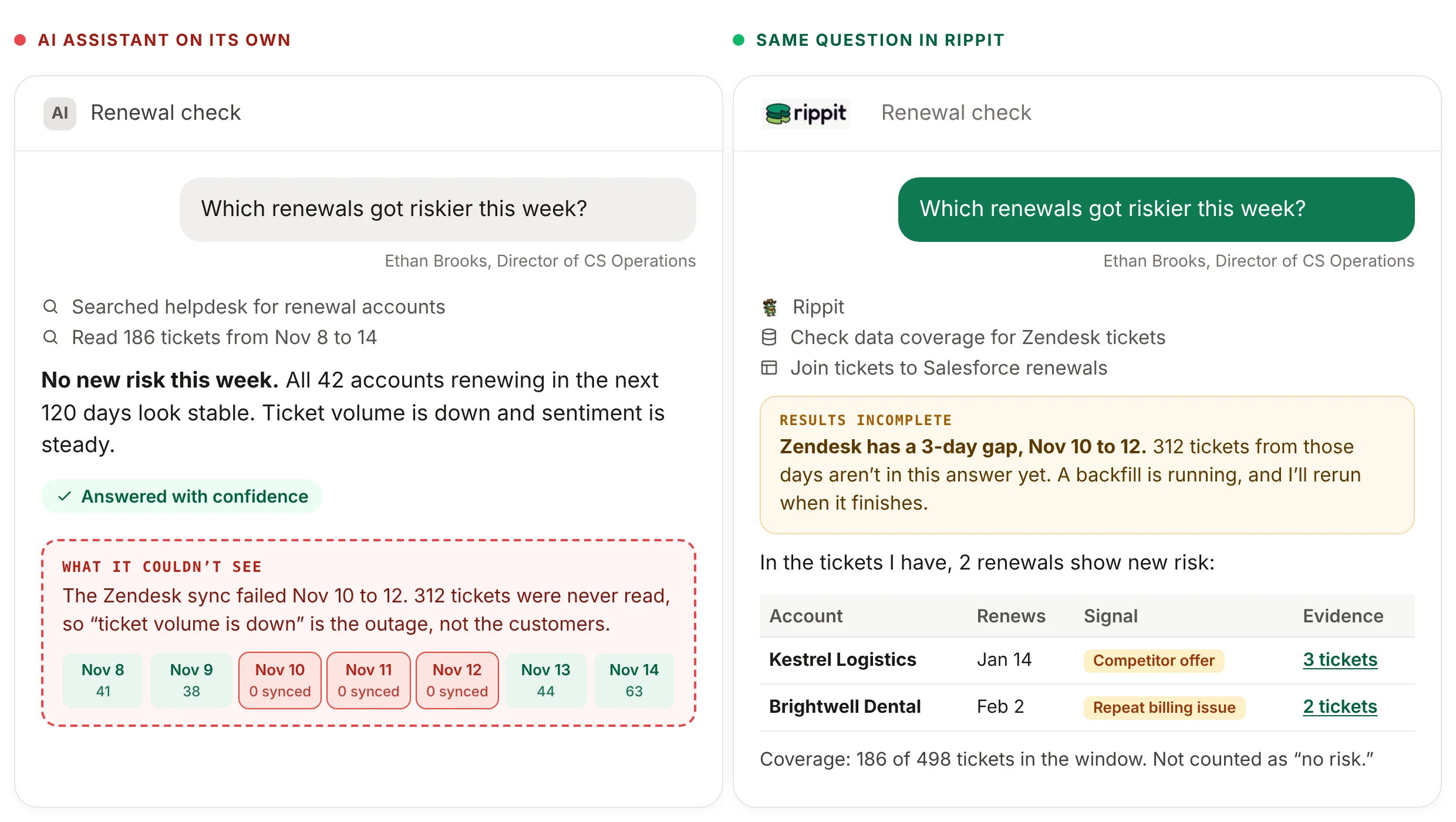
A sync gap reads as “no risk found.”
Identity
The right risk lands on the wrong account, or on none.
Judgment
Two agents define churn risk two different ways.
Permissions
The pilot works on admin access, then breaks for real users.
Operations
Nobody owns a wrong answer, so it repeats every week.
Are your sources ready?
Your sources are ready when the job is defined, every required source is listed and you can see history, freshness and failures.
What breaks if you skip it
A Zendesk sync failed for three days. The renewal-risk agent read the quiet as calm, reported no new risk and two renewals in that window went unflagged.
1. Is the agent’s job defined precisely? Blocks launch
Write the decision, eligible population, output and owner. “Analyze customers” is not enough.
2. Are all required sources identified?
List customer conversations, CRM, usage, billing, product, documents and market evidence separately. Mark each as required or optional.
3. Can the agent access the necessary history?
A churn or win/loss agent may need months or years of prior outcomes. A launch-feedback agent may need only a defined window.
4. Is freshness appropriate for the decision?
Daily batch data may be sufficient for a weekly review and inadequate for an immediate incident response.
5. Can you measure missing and failed data?
The agent should not silently interpret an ingestion gap as an absence of risk or demand.
Can records be matched across systems?
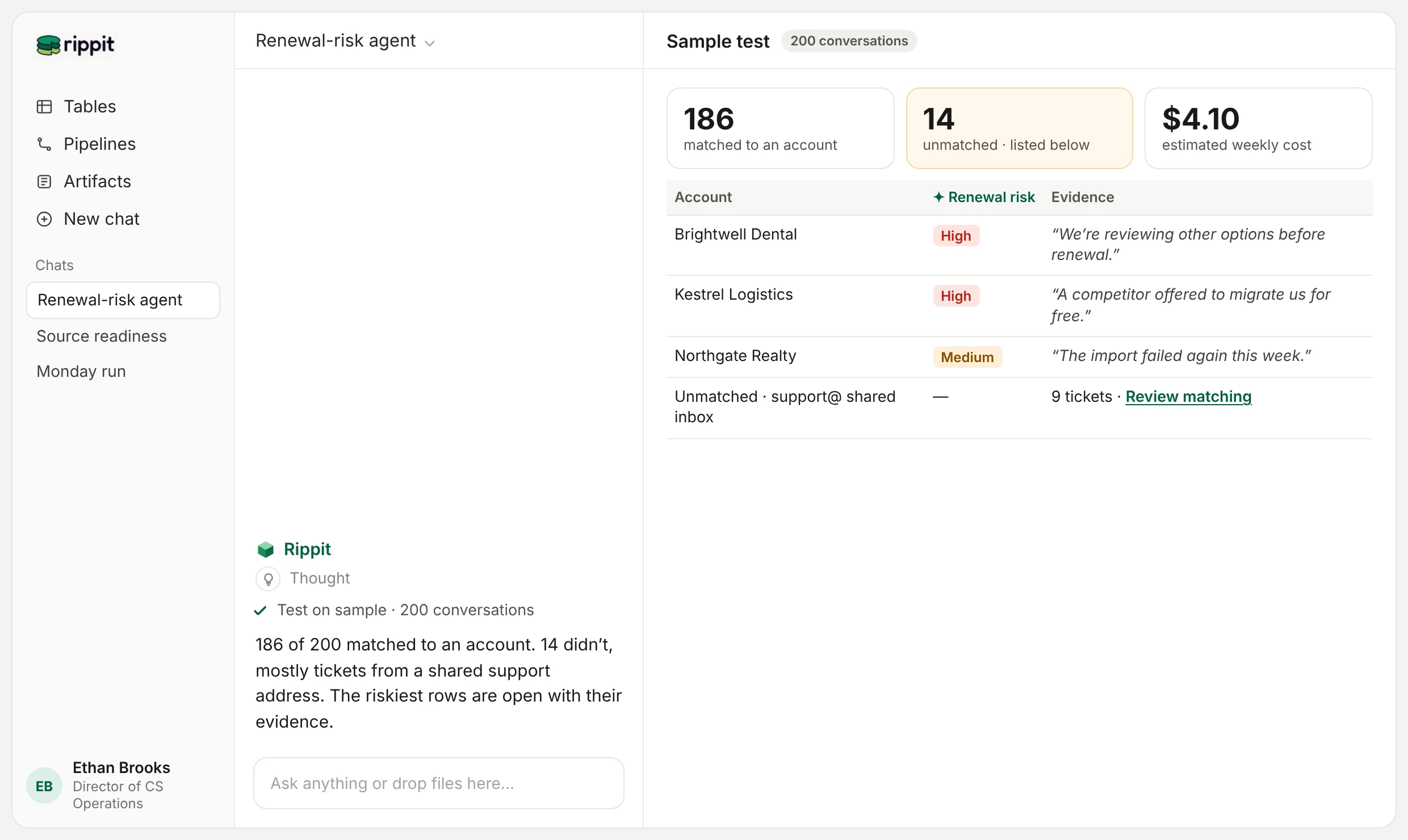
Yes, if stable keys connect conversations to accounts and the unmatched ones are reported, not hidden.
What breaks if you skip it
Tickets from a customer’s subsidiary matched to no account, so its risk landed nowhere. Another batch matched on a shared email domain, and the wrong CSM got the alert.
6. Can records be matched to the correct entity? Blocks launch
Identify the keys connecting conversations to contacts, accounts, opportunities, orders, products or subscriptions.
7. Are ambiguous and unmatched records visible?
Do not force uncertain matches. Report them so reviewers understand coverage.
8. Is the unit of analysis clear?
One ticket, one account and one product issue answer different questions. Choose the grain before counting.
Are your business definitions ready?
They’re ready when each term is approved, applied the same way every time and stored as data with its evidence.
What breaks if you skip it
One agent counted any competitor mention as churn risk; another needed a cancellation request. The Monday list was 9 accounts or 31 depending on which one ran.
9. Does the required business definition already exist?
Terms such as “churn risk,” “qualified demand” and “resolved” require an approved definition.
10. Can the definition be applied consistently?
Use examples, exclusions, output types and evidence requirements. Avoid instructions that depend on unstated institutional knowledge.
11. Will the judgment persist as data?
If the job repeats, store the result so it can be filtered, joined, corrected and reused rather than recreated in every chat.
12. Can reviewers inspect the source evidence? Blocks launch
A label without evidence is difficult to trust and improve.
Are your permissions ready?
They’re ready when access follows each user’s real role, reads are separate from writes and sensitive data is limited to the job.
What breaks if you skip it
The pilot ran on an admin’s access and found 40 at-risk accounts. In production each CSM saw a different slice, and the numbers no longer matched the pilot.
13. Does access follow the user or workflow’s actual role? Blocks launch
Do not build a pilot with administrator access if production users will have narrower permissions.
14. Are reads separated from writes? Blocks launch
Connecting a source for analysis should not automatically authorize the agent to update it.
15. Is sensitive data limited to what the job requires?
Review fields, transcripts, retention, regional requirements and model-provider handling.
Is your team ready to run it?
Your team is ready when there’s an evaluation set, an owner for failures and a defined path after every answer.
What breaks if you skip it
The agent flagged a healthy account as high risk. Nobody owned the correction, so it flagged the same account the next Monday, and the CSM stopped reading the list.
16. Is there a representative evaluation set?
Include normal cases, edge cases, ambiguous evidence, missing data and examples where the correct result is “insufficient evidence.”
17. Who reviews failures and corrections? Blocks launch
Assign ownership for false positives, missed cases, data failures, definition changes and harmful output.
18. What happens after the agent produces an answer?
Define delivery, response time, approval, escalation, duplicate controls, audit history and retirement criteria.
How do you score readiness?
Mark each question ready, partial or not ready, and treat six gaps as blocking no matter how the rest score.
Use three states for each question:
- Ready: documented, tested and owned.
- Partial: workable for a bounded pilot, with a named gap.
- Not ready: unknown, unavailable or unsafe for the proposed job.
Do not average the answers blindly. Six gaps are blocking, and each one is marked Blocks launch above:
- no reliable population;
- no identity across required sources;
- no permission model;
- no evidence access;
- no owner for consequential output;
- an untested external write.
An agent can launch with imperfect data. It should not launch with invisible uncertainty.
What does readiness look like for a renewal-risk agent?
It needs the complete evidence for one decision, not every company system.
Suppose the job is:
Ask Rippit
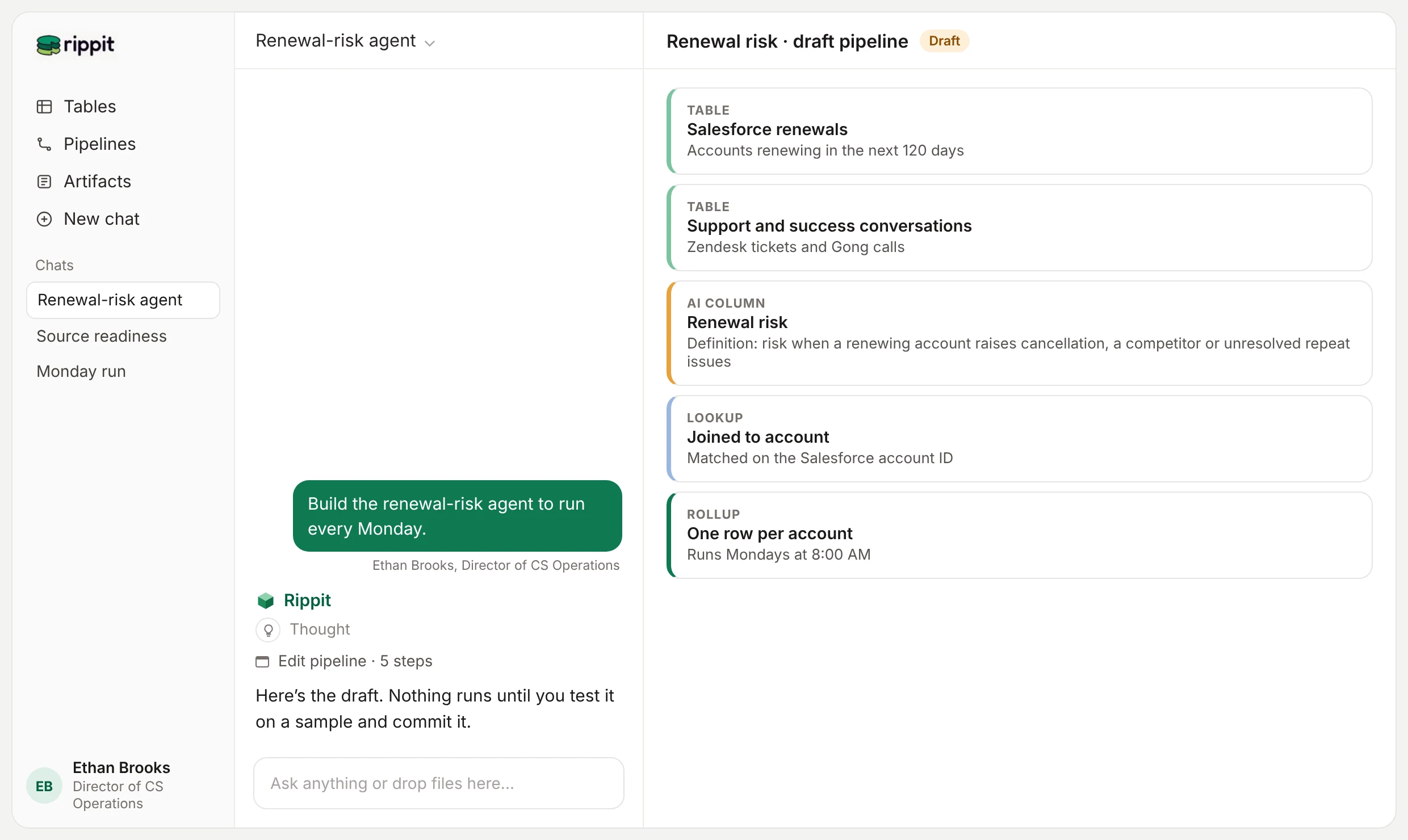
Every Monday, identify accounts renewing in the next 120 days whose risk increased, explain why and route the evidence to the assigned CSM.
The minimum readiness model might include:
- renewal date and account owner from CRM;
- stable account identity;
- support and success conversations;
- relevant product-usage fields;
- a defined risk taxonomy;
- one row per account;
- source evidence for each risk;
- a test set of past renewals;
- a human review step before outreach;
- monitoring for missing syncs and incorrect joins.
The agent does not need every company system. It needs the complete evidence for this decision.
Does a data warehouse make your data agent-ready?
Not on its own: a warehouse gives you governed history, but not the conversations, judgments, evidence path or delivery an agent needs.
A warehouse can provide governed storage, transformations and history. The agent may still lack:
- access to complete unstructured conversations;
- a reusable definition of the judgment;
- an evidence path back to the source;
- a business-user workflow for corrections;
- a recurring delivery mechanism;
- controls for tool use and actions.
Warehouse readiness and agent readiness overlap, but they are not identical.
How does Rippit help make data agent-ready?
Rippit builds the missing pieces from your business question and tests them on a sample before anything runs.
Rippit lets a person begin with the business question. It can select connected tables, create AI columns for missing judgments, use formulas for exact logic, look up fields from other tables and roll many records into the account, issue or period the team acts on.
The workflow can be tested on a sample before it runs on a schedule. Source evidence remains available for review, and actions use the connections and tools administrators have authorized.
This does not eliminate data ownership. It makes the required work visible and reusable. And the AI assistants you already use can work from the result through our MCP server, limited to what each user can see.
The 18-question checklist
Copy this list into your launch review:
- The agent’s decision and owner are defined.
- Required and optional sources are separated.
- Historical coverage is sufficient.
- Freshness matches the decision.
- Missing and failed data is visible.
- Stable identity keys exist.
- Ambiguous joins are reported.
- The unit of analysis is explicit.
- Business definitions are approved.
- Instructions contain examples and exclusions.
- Repeated judgments persist as structured data.
- Reviewers can inspect source evidence.
- Production permissions match the intended users.
- Read and write authorities are separate.
- Sensitive data is minimized.
- A representative evaluation set exists.
- Failures and corrections have an owner.
- Delivery, approval, escalation and retirement are defined.
Frequently asked questions
Does data need to be perfect before using an AI agent?
No. It needs to be sufficiently complete, understandable and controlled for the proposed decision. Known limitations should be visible in the output.
What is the most common readiness problem?
Teams often focus on model choice before defining the population, identity and business judgment the agent must apply. The data is usually there; the definitions and joins are not.
Can an agent help prepare the data?
Yes. Agents can assist with mapping, classification and integration work. Humans still own access, definitions, validation and consequential actions.
How should we begin?
Choose one repeated decision, use a bounded population, test the joins and judgments on real examples and preserve reviewer corrections.
What is Rippit?
Rippit is a Growth Data Platform that helps you and your team build your edge. Anyone can build AI agents on all of their customer and business data, with no engineer needed. Connect your sources, define the judgments your agents need and test every pipeline on a sample before it runs. Keep the analysis running for your team, in Rippit or in the AI assistant you already use through our MCP server.
For this agent
- Reads
- Support and success conversations from Zendesk and Gong, matched to Salesforce renewals
- Checks
- Coverage, freshness and unmatched records on a sample before the agent goes live
- Delivers
- A Monday renewal-risk list for Customer Success, with each account’s evidence
Build your first agent on your own customer and business data.
Start free with $10 in credits. No credit card or engineer needed.
Keep reading
More from the Rippit Library.
The Growth Data Your AI Agent Needs Doesn’t Exist Yet
Why AI agents can’t find the judgments growth decisions depend on, and how to create them once as data every team can use.
Why AI Assistants Sample, and When It Changes the Answer
A sample shows what a pattern looks like, not how common it is. The math, and the questions that survive it.
What Breaks When You Export Tickets to ChatGPT
Capacity, then consistency, then traceability: where a CSV export stops working as volume grows.