
Playbook

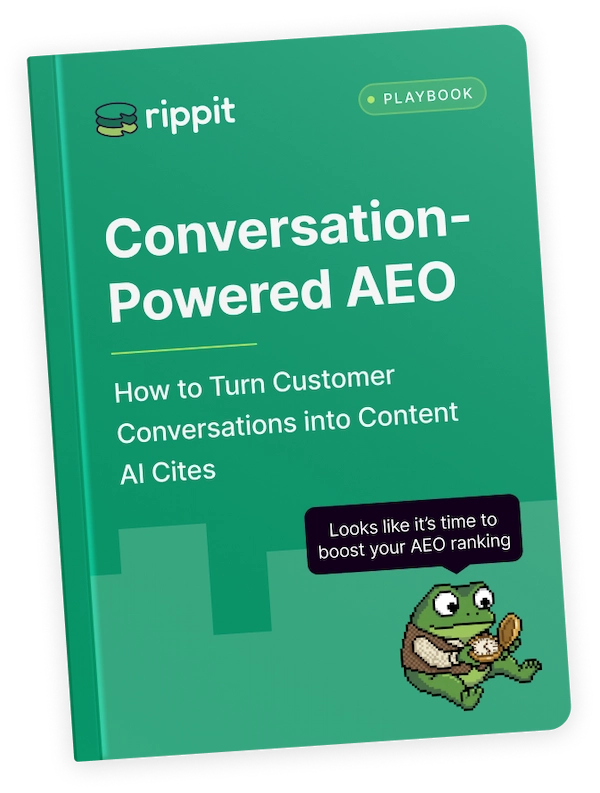
Conversation-Powered AEO

How to turn How to turn customer conversations into content That AI cites

Looks like it’s time to boost your AEO ranking

Download the ebook to share with your team.

Start from your conversations

The keyword research you already own

Most teams plan content from a keyword tool: a list of terms, a volume column, a difficulty score. Useful, but it's the same list your competitors are staring at, and it tells you what strangers type, not what your actual buyers and users struggle with.

You're sitting on something better. Every support ticket and every sales call is a recording of real customers, in their own words, with intent already attached: the problem they have, the question they asked, the comparison they're weighing, the objection that stalled them. That is the highest-signal keyword research in your company, and almost nobody mines it systematically.

A Keyword Tool
  • The same list your competitors are using
  • Tells you what strangers type
vs
Your Conversations
  • A recording of real customers, in their own words
  • Intent already attached: the problem. the question, the comparison, the objection

This guide is the method for doing exactly that: turning your support and sales conversations into a prioritized content plan and finished, citation-ready articles. We built it by running it on our own conversations, and the pillar you may have read on AI Agent Monitoring came straight out of this process.

What "conversation-powered AEO" actually means

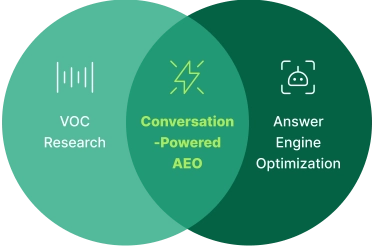
Conversation-powered AEO is the practice of mining your own customer conversations (support tickets and sales-call transcripts) to decide what content to create, write it in the exact language customers use, and structure it so AI answer engines cite you.

It fuses two ideas: voice-of-customer research (what your buyers actually say) and answer engine optimization (getting surfaced by ChatGPT, Perplexity, and Google AI Overviews, not just ranked in blue links).
It's different from classic SEO in three ways:

  1. 1
    The demand signal is first-party

    Instead of a shared keyword database, you start from proprietary data only you hold. That's also what AI engines reward: original, first-party information they can't get from ten other pages.

  2. 2
    The unit is the question, not the keyword

    AI assistants answer questions. Conversations hand you the real questions, phrased the way humans phrase them, which is exactly the input answer-first content and FAQ markup need.

  3. 3
    It compounds

    New conversations arrive every week, so the same pipeline that built your content keeps refreshing it.

Why this matters now

Buyers increasingly start with an AI assistant, not a search box. When the assistant answers, it cites a handful of sources. Studies of AI citations suggest the things that win those slots are answer-first formatting, FAQ structure, original statistics, and direct quotes, more than backlinks or keyword density.

ChatGPT in particular leans heavily on the top of Bing's results, and consistent brand mentions are among the strongest predictors of being cited.

Your conversations are the cheapest way to manufacture all of that. They give you the exact questions to answer, the statistics no competitor can publish (because the data is yours), and the verbatim quotes that make a page feel real.

The teams that mine conversations will become the cited answer for their category. The teams that keep guessing from a keyword tool will not.
The Five-Phase Playbook

Conversations → Demand → Content → Citation

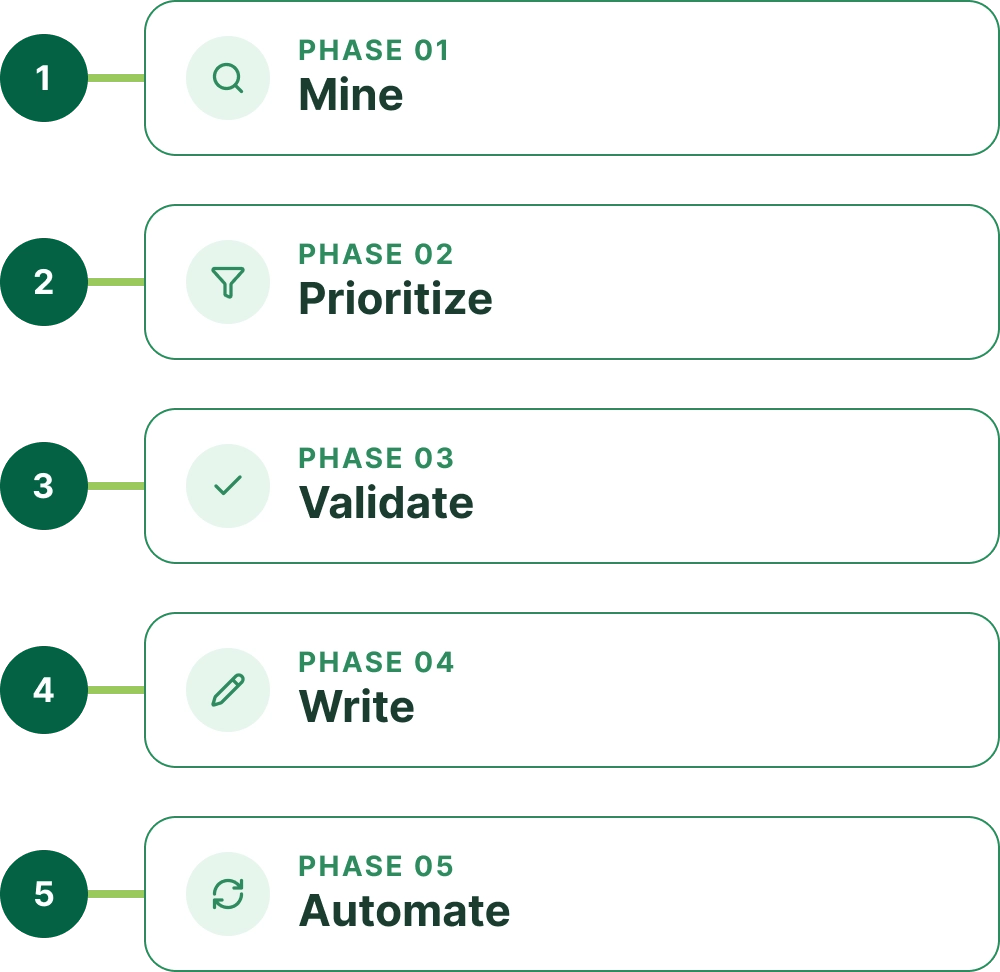
The method runs in five phases. The point is to move from raw dialogue to a published, citable asset, and then to keep it alive.

Phase 1: Mine

  1. 1
    Frame the goal in one sentence

    Decide the outcome before touching data: surface the language and intent customers actually use, then cross it against external search and AI-answer demand to decide what to build.

  2. 2
    Lock scope

    Pick your sources (support tickets for problem-led questions, sales transcripts for category and comparison language), your goal (direct AI answers plus top-of-funnel category SEO), and how you'll estimate volume if you have no SEO tool.

  3. 3
    Work from the full set, not a sample

    Pull the whole conversation window into a working table so your themes reflect true frequency.

  4. 4
    Extract intent from every conversation

    Don't rely on existing tags. Add fresh signal to each conversation (see "The six signals" below). This turns messy dialogue into structured, queryable demand.

Phase 2: Prioritize

  1. 5
    Aggregate by volume and intent

    Group conversations by theme, count them, filter to genuine searchable demand, and split by intent and funnel. Support usually skews informational (great for AEO answers); sales skews commercial (great for category pages).

  2. 6
    Pull verbatim queries per theme

    Keep the real phrasings so your content matches how people actually ask.

  3. 7
    Estimate external demand

    Web-research directional search and AI-answer demand for each theme, clearly labeled as estimates, so you know which internal themes also have outside pull.

  4. 8
    Build a target map

    Cross internal demand (conversation volume) with external demand and winnability. The intersection of high internal signal, real external search, and low competition is where you start.

  5. 9
    Pressure-test adjacencies

    For each target, brainstorm a couple of adjacent angles, then probe the data for existing internal signals before committing. It kills speculative ideas cheaply.

Phase 3: Validate

  1. 10
    Name the play

    Decide the strategy explicitly, for example an AEO land-grab: get cited before the category is crowded and own its vocabulary.

  2. 11
    Baseline who owns the answer

    Confirm the term has demand, then check who AI engines currently cite for it. You'll learn what gap to fill and how aggressive to be.

  3. 12
    Sharpen the frame

    Reposition the topic to a crisper, more ownable term while bridging from the familiar one so search still finds you.

Phase 4: Write

  1. 13
    Draft answer-first and grounded

    Lead each section with the direct answer (engines lift the lead), then support it with conversation evidence. Fold in a real worked example so the piece teaches, not just defines.

  2. 14
    Build a data-powered FAQ with schema

    Turn your top themed questions into an FAQ and add FAQPage JSON-LD. Structured Q&A is the format assistants lift most readily.

  3. 15
    Harden it

    Add anonymized real quotes and customer wins, name concrete examples, include a diagram, trim the FAQ to distinct high-intent questions, and edit out anything that reads generic or machine-made.

  4. 16
    Run a multi-lens edit

    Review through several narrow lenses (clarity, jargon, credibility, specificity), then apply only high-confidence changes. More edits is not better.

Phase 5: Automate

  1. 17
    Schedule a weekly refresh

    Set a recurring task that pulls each week's full conversation volume, filters to the relevant subset, proposes enrichments to your pillar (new FAQ entries, sharper answers), and drafts a net-new post when a strong new theme appears.

This is the step that turns a one-time article into a compounding asset: your content keeps tracking what customers are actually asking, so your authority grows on its own.

The six signals to extract from every conversation

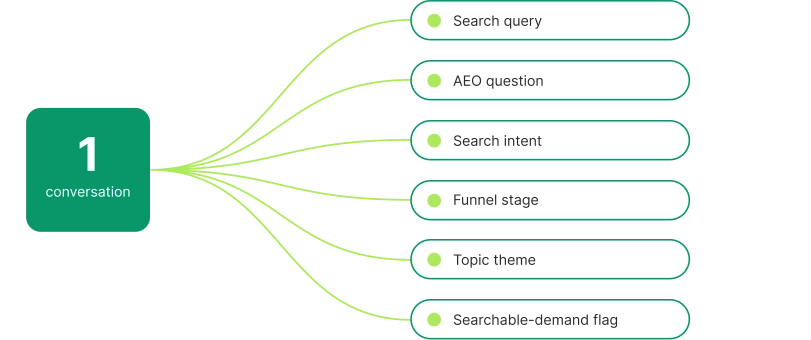
Phase 1, step 4 is the engine of the whole method. For each conversation, generate these, then let them do the filtering:

  1. Search query: The literal term the person would type to solve this.
  2. AEO question: The natural-language question they'd ask an assistant.
  3. Search intent: Informational, commercial, transactional, or navigational.
  4. Funnel stage: Awareness, consideration, decision, or existing-customer support.
  5. Topic theme: A normalized cluster label so similar conversations group together
  6. Searchable-demand flag: Real, generalizable demand versus an account-specific issue with no search value. This one keeps the noise out.

What it produced for us

A worked example

We ran this exact pipeline on our own support tickets and sales calls.

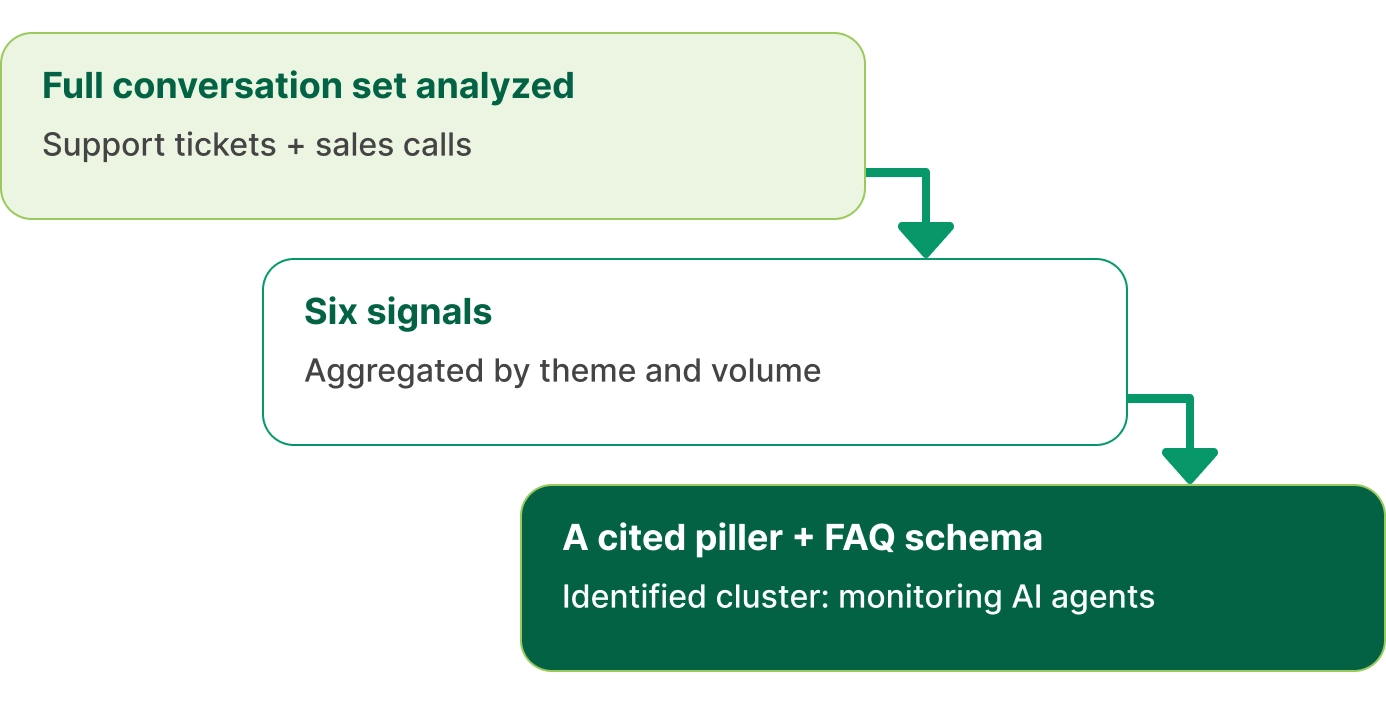
Extracting the six signals across the full set, then aggregating by theme and volume, surfaced a clear, prioritized map of what to create, with the strongest overlap of internal demand and external pull pointing at one cluster: monitoring AI support agents.

Validating that cluster turned up an original, first-party statistic from the conversations themselves: of the conversations about evaluating an AI agent, roughly two-thirds centered on a single worry, whether the bot is accurate or making things up, and about 1 in 11 sales conversations touched the topic at all.

That stat became the spine of the playbook. The verbatim questions became the FAQ. The anonymized customer stories became the proof. The result was a finished, answer-first pillar with FAQ schema, built almost entirely from language our customers had already given us, and a weekly task that keeps it current.

The lesson: The article wrote itself once the conversations were structured. That's the difference between guessing what to publish and reading it straight from your buyers.

FAQ

Questions Rippit customers and prospects ask most — pulled from live conversation data.

Fundamentals

What does it mean to use conversation data for AEO and content?

It means mining your own support tickets and sales-call transcripts to find the exact questions and language customers use, then turning those into content written answer-first and structured so AI search engines cite it. Your conversations become both the keyword research and the proof.

What is AEO, and how is it different from SEO?

AEO (answer engine optimization) is optimizing to be the source AI assistants cite when they answer a question, rather than only ranking a link. SEO targets search result positions; AEO targets the answer itself, which rewards answer-first writing, FAQ structure, original data, and clear citations.

Why does first-party data matter for AI search visibility?

Because AI engines favor original information they can't find on ten other pages. Your customer conversations are proprietary, so the statistics, questions, and examples you pull from them are unique by definition, which is exactly the "information gain" that earns citations.

How to do it

How do I turn support tickets into content ideas?

Pull a few months of tickets, extract the underlying question and intent from each, cluster them by theme, and rank by volume. The high-frequency, generalizable questions are your content backlog, already validated by real demand.

How do I mine sales-call transcripts for content topics?

Read the calls for the questions, objections, and comparisons prospects raise, then cluster them. Sales conversations skew commercial, so they surface category terms and "vs competitor" angles that support tickets miss.

How do I find the exact questions my customers actually ask?

Don't paraphrase them, extract them. For each conversation, capture the natural-language question the person was really asking. Aggregated, those verbatim questions map one-to-one onto headings and FAQ entries.

How do I prioritize which questions to create content for?

Cross internal demand (how often a theme appears in conversations) with external demand (rough search and AI-answer interest) and winnability (how crowded the answer already is). Start where all three line up.

AEO Mechanics

How do I get my content cited by ChatGPT, Perplexity, and Google AI Overviews?

Answer the question directly in the first 40-60 words, add FAQ schema, include an original statistic and a direct quote, and earn consistent brand mentions across third-party sites. Studies of AI citations point to these factors over backlinks or keyword density.

Does FAQ schema and answer-first formatting actually help?

Yes. Answer engines lift self-contained question-and-answer blocks most readily, and FAQPage structured data makes them machine-readable. Pair the visible FAQ with matching JSON-LD and keep the two identical.

Tools and Proof

What tools analyze support tickets and sales calls for content insights?

Conversation analytics platforms (Rippit) read full transcripts at scale and let you add AI columns for intent, theme, and the question behind each conversation, so you can aggregate demand instead of reading tickets one by one.

How do you measure whether conversation-driven content gets cited or ranks?

Track three things: whether AI assistants name you when asked your target questions (check monthly), movement on the target terms in search and Bing visibility, and how often third-party pages mention your brand alongside the topic.

Table of Contents

Get the ebook

Formatted for sharing with your team.

Share this post

Unlock Conversation-Powered AEO

Rippit finds the questions your customers actually ask, so you can write the answers AI engines cite.

All things are one. When we perceive this, we see that the flowers, the trees, and the stars are all part of our own body."

Where conversations become

insights

actionable data

business intelligence

enterprise visibility

insights

I fear not the man who has practiced 10,000 kicks once, but I fear the man who has practiced one kick 10,000 times
Peloton
legal zoom